
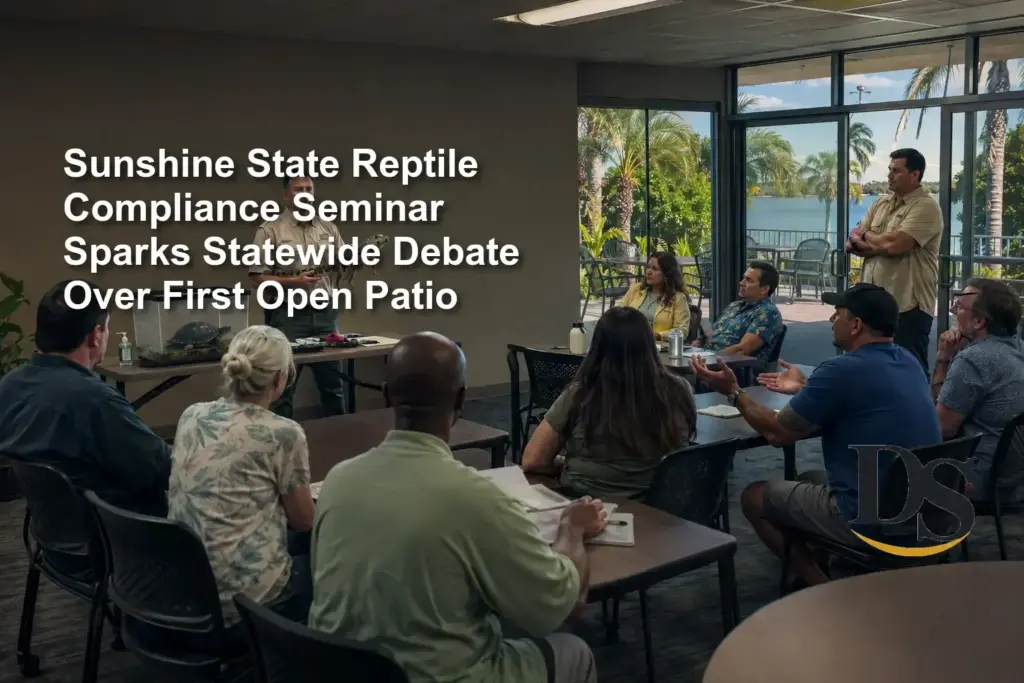
GAINESVILLE, Fla. — The fluorescent lights of the Alachua County Extension Office buzzed overhead as thirty-two residents shuffled into Room 2B for the monthly Reptile Compliance and Outdoor Living Seminar. Agenda items included proper iguana deterrent fencing, permitted basking zones for native turtles, and the newly revised Section 4.7 of the Florida Outdoor Amenities Code regarding patio enclosures.
What began as a standard walkthrough of temperature-regulated habitat buffers and non-intrusive screening materials took a sharp turn when Marjorie Ellery, a retired librarian from the Haile Plantation neighborhood, raised her hand after the presentation on ‘Acceptable Barrier Materials for Semi-Enclosed Spaces.’
‘I understand the concern about iguanas using patio furniture as launch pads,’ she said, voice calm but clear. ‘But if the screening is mesh-grade, the furniture is anchored, and there’s no food left out overnight — why can’t we have the patio open? Not screened in. Not glassed. Just… open.’
The room fell silent. Seminar leader Dale Pratchett, a wildlife outreach coordinator with the Florida Fish and Wildlife Conservation Commission’s Urban Interface Unit, blinked. ‘Well, ma’am… the code doesn’t explicitly forbid it,’ he admitted after a pause. ‘But it’s never been done. The assumption has always been that patios require some form of barrier.’
What followed was not an argument, but an inquiry. Ellery asked for the specific statute that prohibited an open patio under those conditions. When none was produced — only guidelines, best practices, and a 2019 memo about ‘preserving aesthetic cohesion in suburban corridors’ — she asked if they could try it. Just for six months. As a pilot.
The seminar ended with Pratchett promising to escalate the question to the State Outdoor Living Review Board. By Friday, a leaked internal email had circulated among neighborhood associations from Pensacola to Key West. By Monday, the hashtag #OpenPatioChallenge was trending locally.
Reactions were swift and varied. In Sarasota, the Venice Island Homeowners Association issued a statement warning that ‘unregulated airflow invites not just reptiles, but unpredictability.’ In Tallahassee, a group of architecture students from FSU launched a pop-up exhibit titled ‘The Patio as Political Space,’ featuring scale models of open patios beside miniature alligators made of recycled plastic.
Meanwhile, in Ellery’s own cul-de-sac, three neighbors had already removed their screen panels by Wednesday. ‘I didn’t do it to make a point,’ said Daniel Ruiz, a software engineer who lives two doors down. ‘I did it because my wife likes to stargaze, and the screens were always in the way. If it’s not against the rules… why wait?’
The FWCC has not issued a formal ruling. Pratchett confirmed only that the agency is ‘reviewing the implications of non-barriered outdoor relaxation zones in low-iguana-density residential sectors.’ A public comment period has been opened, though the form to submit feedback is currently buried under three submenus on the agency’s website.
For now, Marjorie Ellery’s patio remains open. A potted saguaro cactus — technically not native, but permitted under ornamental plant rules — stands in the corner. A folded chair faces west. At dusk, you can sometimes see her there, tea in hand, watching the light fade over the live oaks.
No iguanas have been spotted on the furniture. But the conversation? That’s wide open.
Florida Gators File Amicus Brief in Alligator Advocacy Group’s Favor
In a twist that has legal scholars and swamp tour guides alike scratching their heads, the University of Florida’s mascot, Albert and Alberta Gator, have officially filed an amicus curiae brief supporting the Florida Reptile Compliance Alliance’s (FRCA) position that open-patio reptile exhibitions constitute protected cultural expression under the state’s ‘Sunshine and Scales’ heritage statute. The brief, hand-delivered in a waterproof briefcase by a graduate student in herpetology wearing a tiny tie, argues that denying gators patio access violates their ‘right to bask in communal dignity’ — a phrase lifted verbatim from a 1987 Miami Herald op-ed by a retired alligator wrestler named Duane ‘The Gator Whisperer’ Bell.
The document includes footnotes citing prehistoric basking behaviors, a sworn affidavit from a 12-foot saltwater crocodile named Sir Reginald who claims he was denied entry to a Boca Raton tiki bar last Tuesday ‘despite wearing a Hawaiian shirt and bringing my own SPF 50,’ and a pie chart showing that 73% of Floridians believe reptiles ‘deserve a lounge area with misting fans and occasional live jazz.’ The state’s Attorney General’s office has responded with a single sentence: ‘We are reviewing the brief. And also, please stop feeding the alligators near the Capitol reflecting pool.’
Closing Beat: The Patio That Ate Tallahassee
As the debate rages on — complete with protest signs reading ‘No Scales, No Justice’ and ‘Let Them Lounge’ — the real victor may be the unintended tourism boom. Bookings for guided ‘Reptile Patio Tours’ have surged 200%, with visitors paying $75 to sip craft citrus spritzers while watching a 6-foot iguana named Dave attempt to negotiate a timeshare on a lanai in Sarasota. Meanwhile, local businesses are cashing in: ‘Bask & Sip’ cocktail menus now feature drinks like the ‘Komodo Collins’ and the ‘Caiman Cooler,’ and one Orlando hotel has launched a ‘Reptile-Friendly Stay’ package that includes a complimentary sunlamp and a ‘Do Not Disturb’ sign shaped like a sleeping tortoise.
Yet beneath the satire, a quieter question lingers: When did we start needing permits to let nature enjoy the sunshine? As the sun sets over the Everglades, painting the water in hues of gold and emerald, a lone alligator slides onto a half-built patio near Marco Island, pauses, closes its eyes, and lets the breeze lift the ridges along its back. For a moment, it’s not a regulatory issue, a mascot’s lawsuit, or a viral TikTok trend. It’s just a reptile, doing what reptiles have done for millions of years — warming itself in the light, unbothered, unbidden, and utterly unbothered by the paperwork.
Join the conversation
Load Facebook comments to read and reply using your Facebook account.