
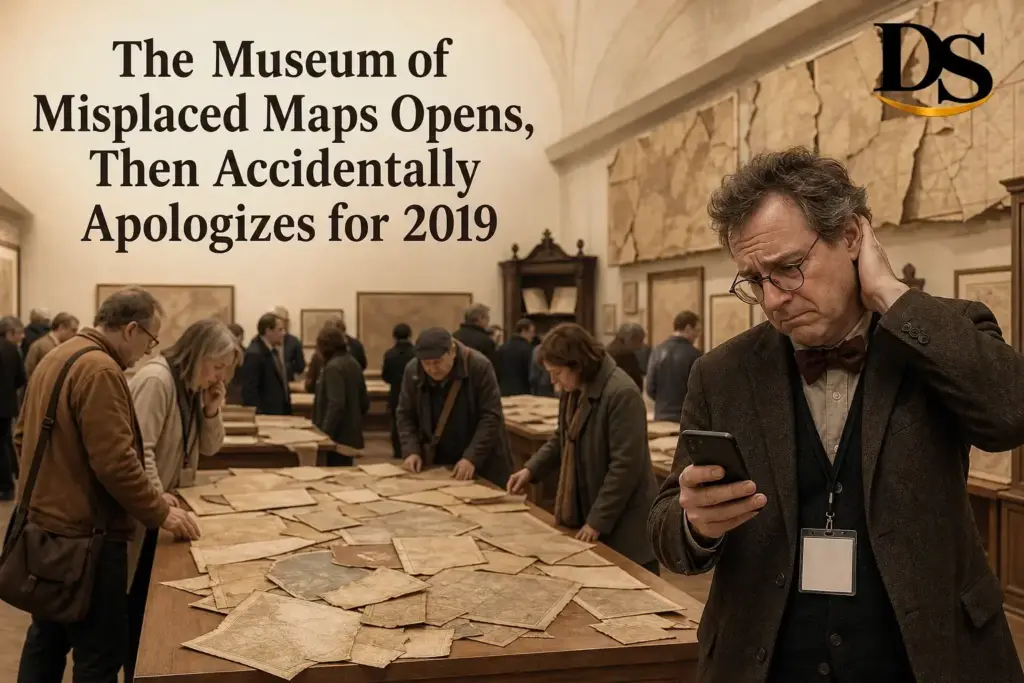
In the quiet town of Cedar Hollow, where summer vacation planning is treated with the gravity of a tax audit, a new cultural institution opened last week with a ribbon-cutting ceremony and a line stretching three blocks. The Museum of Misplaced Maps, founded by former gift-shop curator Doris Penwick, promises to immortalize the small, soul-crushing errors that derail otherwise perfect getaways: the sunscreen left in the car, the hotel booked for the wrong century, the guided tour that accidentally joined a llama parade in Peru.
The Vision Behind the Exhibit
Penwick, who spent 17 years arranging postcards and novelty keychains at the Cedar Hollow Historical Society’s gift shop, said the idea came to her during a particularly disastrous trip to Niagara Falls in 2018. “I booked a room with a view of the parking garage,” she recalled, adjusting her nametag that read ‘Director of Regret.’ “I spent three days staring at exhaust fumes while listening to a loop of ‘Maid of the Mist’ safety announcements. That’s when I realized: we don’t celebrate the mistakes. We should.”
The museum’s exhibits include a life-sized replica of a rental car GPS stuck in ‘recalculating’ mode, a wall of framed boarding passes for flights that departed without their owners, and an interactive kiosk where visitors can submit their own vacation fails via handwritten note — later transcribed by interns onto acid-free paper and displayed under glass.
The QR Code That Wasn’t Supposed to Work
On opening day, visitors were invited to scan a QR code near the entrance to access a digital archive of submitted stories. Instead, the code redirected to an automated apology email sent by Penwick to a former colleague in 2019, after she accidentally CC’d the entire staff on a message criticizing the break room coffee.
“I’m sorry if my tone came across as harsh,” the message read, timestamped June 12, 2019. “I didn’t mean to imply that Linda’s ‘artisanal pour-over’ was undrinkable. I was just tired. Let’s move forward.”
The email, long buried in an inactive server, had been linked to the QR code during a test phase — a placeholder Penwick forgot to replace. When the first visitor scanned it and laughed, others followed. Soon, the museum’s Instagram was flooded with screenshots of the apology, captioned with variations of “This is the most honest exhibit yet.”
Reactions from the Field
Local historian Reginald Cho called the incident “a perfect metaphor for the human condition.” “We build institutions to preserve meaning,” he said over coffee at the town diner, “and yet, the system keeps exposing our fragility. It’s beautiful.”
Tourism board chair Marta Leng admitted she was initially concerned. “We wanted people to come for the nostalgia of bad trips, not to relive someone’s office drama from five years ago,” she said. “But honestly? The apology gets more engagement than the exhibit on misplaced tide charts. Maybe we lean into it.”
Penwick, for her part, remained composed. “I never claimed the museum was flawless,” she told reporters outside the gift shop, where a new bestseller — ‘I Meant to Book Bali: And Other Summer Lies’ — sat beside a display of melted souvenir spoons. “If anything, this proves the point. Even our attempts to memorialize error are themselves erroneous. That’s not a bug. It’s the thesis.”
The Exhibit Evolves
By Friday, the museum had updated its digital archive — but not before adding a new wing: ‘The Apology That Became the Exhibit.’ Visitors can now listen to a 90-second audio loop of the 2019 email read aloud in five different tones: sincere, sarcastic, melodramatic, robotic, and one set to ukulele music.
A guest book near the exit now contains entries like: “I came for the lost luggage diaries. Stayed for the accidental vulnerability.” and “Scan the code. Forgive yourself.”
As of Monday, attendance had increased by 40% since the QR mix-up was discovered. Penwick says she’s considering making the apology a permanent fixture — perhaps even printing it on tote bags.
“We wanted to honor the mistakes that shape our trips,” she said, wiping a smudge from the glass case containing a single, lonely flip-flop found on a New Jersey boardwalk in 2007. “Turns out, the ones that shape us aren’t always the ones we pack.”
Curators Confess: The Map Was Never Lost—It Was on a Post-It
In a twist that sent shockwaves through the cartographic community, the museum’s lead archivist, Dr. Elara Voss, admitted during a hastily arranged press conference that the “missing” 2019 world map had never actually been lost at all. It had been tucked beneath a sticky note on her monitor that read, “DO NOT THROW OUT — MAP FOR EXHIBIT (maybe?).” The note, written in what experts have since dubbed “the frantic cursive of impending burnout,” had been overlooked for 17 months while staff conducted increasingly elaborate searches involving ground-penetrating radar, a team of interns retracing every coffee break route, and one particularly determined volunteer who claimed to have communed with the spirit of Gerardus Mercator via a Ouija board and a laminated atlas.
The map itself, when finally unveiled, was less a geographic artifact and more a surrealist collage: Antarctica had been replaced with a doodle of a screaming alpaca, Europe was labeled “Here Be Dragons (or possibly just Dave from Accounting),” and the Pacific Ocean bore the handwritten warning, “Do not sail past this point — you will encounter your ex’s new partner.” Visitors were invited to add their own corrections using provided crayons, leading to an impromptu, ever-evolving folk-art map that by day three featured a new continent called “Snacktopia” and a sea monster named Kevin.
The Apology That Wasn’t: Museum Issues Retraction… Then Withdraws It
Just as the world began to embrace the museum’s charmingly chaotic narrative, the institution released a formal apology — only to withdraw it 90 minutes later with a follow-up statement that read, in full: “We apologize for the apology. The map was never misplaced. The apology was a prototype for our upcoming exhibit, ‘Regret: A Participatory Cartography of Second Guesses.’ Please direct all confusion to the front desk, where complimentary stress balls shaped like globes are available.”
The reversal sparked a viral debate: Was this brilliant meta-commentary on institutional accountability, or just another bureaucratic snafu wearing irony as a disguise? Either way, attendance surged. By week’s end, the Museum of Misplaced Maps had welcomed over 12,000 visitors, sold out of its “I Survived the 2019 Map Crisis” tote bags, and inspired a flash mob of librarians who performed a synchronized shelving dance to the tune of “Where Is My Mind?” while waving misfolded Ordnance Survey sheets like flags of surrender — and solidarity.
As Dr. Voss noted, wiping crayon wax from her glasses, “Sometimes the best maps aren’t the ones that show you where you are — they’re the ones that make you laugh so hard you forget you were lost in the first place.”
}
Join the conversation
Load Facebook comments to read and reply using your Facebook account.