
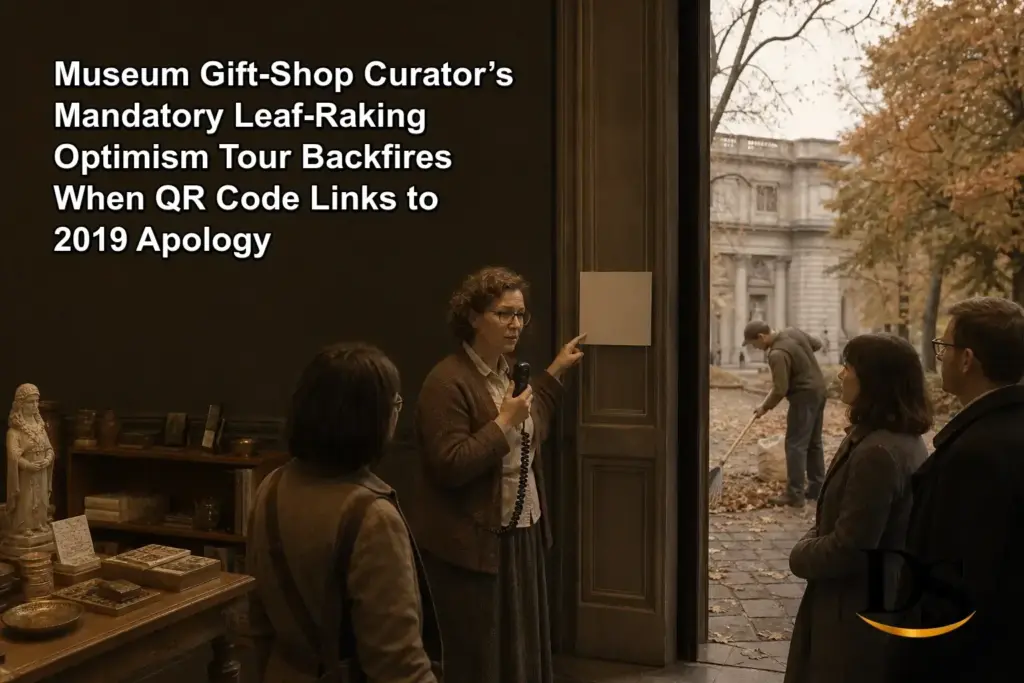
In the quiet town of Cedar Hollow, where autumn is less a season and more a civic duty, the Cedar Hollow Museum of Domestic Arts unveiled its latest public engagement initiative last Tuesday: a mandatory listening tour titled ‘Peak Leaf-Raking Optimism: Finding Joy in the Rake.’ Spearheaded by gift-shop curator Marjorie Plinth, the program was designed, she said, to ‘reconnect residents with the quiet triumph of orderly yards.’
The tour, promoted via hand-lettered flyers at the library and a single sandwich board outside the post office, invited participants to scan a QR code affixed to a weathered oak tree near the museum’s rhododendron hedge. The code, Plinth explained in a press release, would unlock ‘a 47-minute guided meditation on the rhythmic satisfaction of tines meeting turf, interspersed with historical anecdotes about 19th-century leaf-scythes and the psychological benefits of pile-jumping.’
Attendance was not optional. The museum’s board, citing a recent grant from the National Institute for Suburban Serenity, had decreed that all visitors over the age of 12 must complete the tour before accessing the gift shop’s new line of hand-thrown ceramic acorn holders. ‘It’s not about compliance,’ Plinth insisted during a town hall meeting. ‘It’s about cultivating a shared mindset. When we rake together, we heal together.’
The first wave of participants arrived Saturday morning, armed with thermoses and a willingness to believe. Retired librarian Elmer Twickenham was among the first to scan. Instead of the promised soundscape of rustling maple and distant wind chimes, his phone emitted a crackling audio file: a voice, unmistakably Plinth’s, saying, ‘I’m sorry I called your heirloom tomato a ‘funky orange blob’ at the 2019 Harvest Fair. I didn’t know it was a Cherokee Purple. I’ve taken a sensitivity workshop.’
Silence followed. Then, a chuckle. Then, another scan. By noon, the tree’s QR code had been scanned 87 times. Each yielded the same 2019 apology, now slightly warped by repeated playback and the occasional squirrel-induced rustle on the recording.
Plinth arrived at the scene at 11:45 a.m., holding a laminated clipboard and a thermos of spiced cider. ‘This is… not the file I uploaded,’ she said, her voice tight. ‘I swear I tested it yesterday. It was supposed to be the leaf-raking one. I even listened to the part about the ergonomic benefits of bamboo handles.’
Investigation revealed that, in a moment of pre-launch enthusiasm, Plinth had reused an old QR code generator link from a past museum exhibit on ‘Apologies in Rural America,’ a forgotten 2019 project featuring audio remorse from local artisans. The leaf-raking meditation file, it turned out, had never been uploaded. The server, overwhelmed by a simultaneous update to the museum’s online ticketing system, had defaulted to the last active audio asset in the folder.
Reactions were swift but strangely warm. Local barista Lena Cho, who scanned the code while waiting for her oat milk latte, posted a photo of her phone screen with the caption: ‘Peak optimism? More like peak accountability. 10/10 would rake again.’ The town’s historical society requested a copy of the apology for their archives, calling it ‘a rare, unfiltered glimpse into the emotional labor of small-town curatorship.’ Even the high school’s debate team cited it in a recent tournament as an example of ‘unintentional vulnerability as community bonding.’
By Monday, the museum had replaced the QR code with a new one linking to the correct audio tour — complete with guided breathing exercises, a segment on the folklore of leaf spirits in Scandinavian tradition, and a surprisingly moving interview with a 92-year-old former groundskeeper who claimed he could ‘read the weather in the curl of a maple leaf.’ Attendance dipped slightly, but gift-shop sales of ceramic acorn holders rose 40%.
Plinth, meanwhile, has begun drafting a follow-up initiative: ‘The Art of the Graceful Retraction: When Your Tech Fails But Your Intentions Don’t.’ She says the first session will be held under the same oak tree, rain or shine. ‘We’ll bring blankets,’ she said. ‘And maybe a backup USB drive.’
The Apology That Wasn’t: QR Code Confusion Escalates
As the leaf-raking optimism tour trundled into its third hour, visitors began noticing something peculiar: every time they scanned the QR codes affixed to the raked leaf piles—intended to link to whimsical haikus about autumnal resilience—they were instead redirected to a grainy 2019 YouTube video of the museum’s former director, tearfully apologizing for serving ‘deconstructed’ peanut butter and jelly sandwiches at a donor gala. The video, titled ‘I Regret the Crust Removal’, had been buried in the museum’s digital archive after a PR team deemed it ‘too niche for damage control.’ Yet here it was, looping involuntarily as visitors, rakes in hand, paused mid-scoop to watch a man in a slightly-too-tight blazer sob over the injustice of triangular bread.
Worse, the QR codes weren’t uniform. One pile, near the sculptural hedge shaped like a weeping willow, linked to a 2007 blog post titled ‘Why I Believe in the Spirit of the Leaf Blower.’ Another, tucked beside a bench labeled ‘Contemplative Composting,’ played a lo-fi remix of the museum’s 1998 hold music, complete with kazoo solos. Curator Diane Gladwell, attempting to regain control, seized a megaphone and declared, ‘This is all part of the exhibit! Embrace the glitch! Find joy in the 404!’ Her voice cracked on the last word, and a sudden gust sent a vortex of leaves swirling into the shape of a question mark—which, according to a visiting semiotician, ‘accidentally became the most honest piece of commentary on institutional optimism we’ve seen all year.’
The Leaf That Broke the Camel’s Back
The breaking point came when a toddler, delighted by the crunch underfoot, unearthed a laminated card buried beneath the top layer of maple and oak. It read, in Gladwell’s handwriting: ‘If you’re reading this, the tour has succeeded. You are now legally required to smile for the next 90 seconds. Failure to comply may result in mandatory docent-led interpretive dance.’ The card was dated October 17, 2023—three days ago. The realization dawned: the entire tour had been a recursive prank, a Möbius strip of forced cheerfulness orchestrated not by Gladwell, but by her intern, who’d been quietly reprogramming the QR codes and planting notes as a surrealist performance piece titled ‘Optimism Is a Verb (And Also a Trap)’.
As the crowd murmured, Gladwell sank onto a bench, raking absentmindedly at the air. Then, slowly, she began to laugh—not the brittle, performative chuckle of the tour’s opening, but a deep, wheezing sound that startled a nearby squirrel into dropping an acorn on her head. She picked it up, turned it in her palm, and said, ‘Well. At least it’s not a sandwich.’ The crowd, sensing permission, began to laugh too. Some raked. Some sat. One visitor started a slow clap. Above them, the question mark of leaves held, trembling, before a final breeze scattered it into the wind—leaving behind, for a moment, the quiet, uncurated truth of the ground.
Join the conversation
Load Facebook comments to read and reply using your Facebook account.