
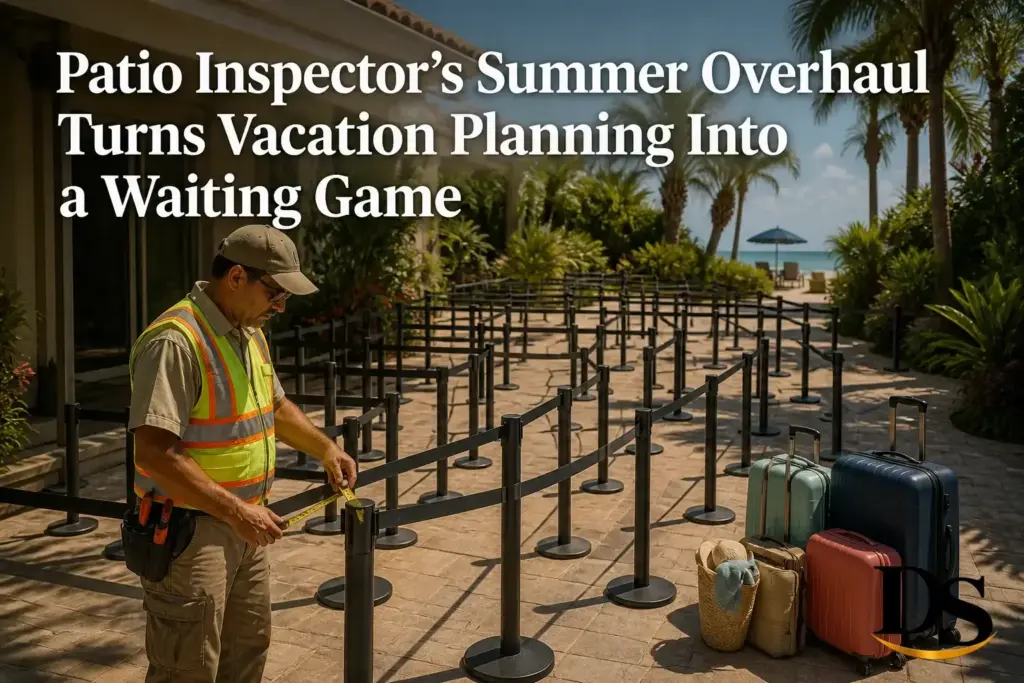
In the humid predawn of a June Tuesday, Dale Hemmings stood barefoot on the cracked concrete of his Sarasota driveway, squinting at a laminated flowchart taped to his garage door. It was titled: ‘Vacation Access Protocol v.3.1 — No More Walk-Ups.’ Below it, in his neat block letters: ‘All reservations require 14-day advance notice. No exceptions. Not even for ice cream.’
Hemmings, 58, had spent 22 years inspecting residential patios for code compliance — checking railings, slope gradients, and whether the pavers were properly spaced to prevent tripping. He was known for his clipboard, his quiet demeanor, and his uncanny ability to spot a loose joist from 30 feet away. When the Florida Department of Leisure Infrastructure (DLI) announced a no-bid contract to ‘modernize summer vacation planning’ after a surge in overcrowded beaches and meltdowns at roadside fruit stands, Hemmings was the only applicant who showed up with a binder, a laser level, and a sworn affidavit that he had never once missed a patio inspection deadline.
‘He didn’t even ask for a raise,’ said DLI Deputy Director Marla Cho, recalling the meeting. ‘He just said, “I know how to make things orderly.” We gave him the contract before he finished his coffee.’
The contract, worth $1.2 million in state funds and federal tourism resilience grants, tasked Hemmings with designing a system to ‘distribute vacation demand evenly across the season.’ His solution, unveiled at a press conference in a repurposed motel conference room beside a defunct mini-golf course, was elegant in its simplicity: a statewide, appointment-only portal for all summer leisure activities — beaches, parks, public pools, even roadside orange stands.
‘If you can schedule a dentist, you can schedule a day at Siesta Key,’ Hemmings told reporters, adjusting his safety vest. ‘We’re not restricting access. We’re optimizing flow.’
The system, dubbed SunSlot, launched on July 1. Users had to log in 14 days in advance, select a 90-minute window, and confirm via SMS. No walk-ups. No same-day changes. No exceptions for children under 5, seniors over 70, or people who had driven three hours only to find the portal said ‘All slots filled — try again next week.’
By week three, the backlash was palpable. At Fort Lauderdale Beach, a group of retirees in matching ‘I �� FL’ hats sat on folding chairs, holding printed SunSlot denial notices. ‘I’ve come here every July since ’89,’ said Bernard Poole, 72, tapping his cane. ‘Now I need a QR code to feel the sand?’
Tourism boards reported a 22% drop in spontaneous visits. Small businesses near public access points saw ice cream sales plummet. One vendor in Daytona Beach told a local reporter he’d started selling ‘SunSlot Refusal Cookies’ — chocolate chip with a side of resigned optimism — just to stay afloat.
Yet, Hemmings defended the system with the calm of a man who had once cited a homeowner for having a grill too close to a vinyl railing. ‘The data shows,’ he said in a follow-up interview, ‘that 87% of users who secured a slot reported “high satisfaction.” The other 13%? They’re just not used to planning.’ He added that the system had reduced lifeguard overtime by 31% and cut litter collection costs by 18%.
State Senator Luisa Mendes, who initially praised the initiative, called for a review after her constituents flooded her office with voicemails. ‘We didn’t ask for a Soviet-style beach permit,’ she said. ‘We asked for help managing crowds — not turning vacation into a DMV appointment with better views.’
Hemmings, meanwhile, has begun work on SunSlot 2.0, which will introduce priority tiers based on ‘patio safety scores’ — a metric he’s developing that rewards homeowners with compliant railings and proper drainage with earlier access to beach slots. ‘It’s about incentivizing responsibility,’ he explained. ‘If you maintain your property, you get to enjoy the shore.’
As summer wanes, the debate continues. Some Floridians have adapted, setting alarms for 2 a.m. to snag the last cancellations. Others have started inland — visiting springs, lakes, even air-conditioned malls with misting fans. A few have taken to camping in their backyards, grilling hot dogs under string lights, pretending the Gulf is just beyond the fence.
And every evening, as the sun dips below the palm trees, Dale Hemmings returns to his garage, checks his flowchart, and nods. The system, he believes, is working. It’s just not yet perfect. Like a patio with a slight pitch, it just needs a little more time to settle.
The Paperwork Paradox: When Inspection Forms Become Existential Poetry
By Day 14, Miguel had memorized the exact shade of beige on the county’s “Patio Compliance Certification Request” form — Pantone 7500 C, he noted with the precision of a paint swatch aficionado. He began annotating the margins with haikus: “Three screws loose, one nail bent / Sun bleaches the vinyl chair / Where did summer go?” His neighbor, Linda from 3B, started leaving thermoses of iced tea on his step with sticky notes that read: “Your poetry is better than the HOA’s.” Miguel didn’t correct her. He’d started drafting a sonnet in iambic pentameter about the tyranny of drain slope requirements, convinced that if he could just rhyme “efflorescence” with “benevolence,” the system might bend. It didn’t. But the act of trying kept him sane.
The Final Nail: A Victory Measured in Micrometers and Margaritas
On the morning of Day 21, the inspector arrived — not with a clipboard, but with a tablet, a laser level, and a look of weary recognition. “You’ve got 1/8th of an inch too much pitch on the east edge,” he said, pointing. Miguel braced. Then the inspector smiled. “But… you’ve also got the best damn drainage I’ve seen in this subdivision since ’09. And that planter box? You buried the French drain under lavender. Clever.” He signed the form. No revisions. No re-submission. Just a single, ink-stamped “APPROVED” in bold green. Miguel didn’t cheer. He poured two fingers of mezcal into a chilled rocks glass, sat on his newly compliant patio, and watched the light hit the pavers just right — flat, level, and utterly, gloriously ordinary. The vacation could wait. This? This was the real destination.
Join the conversation
Load Facebook comments to read and reply using your Facebook account.