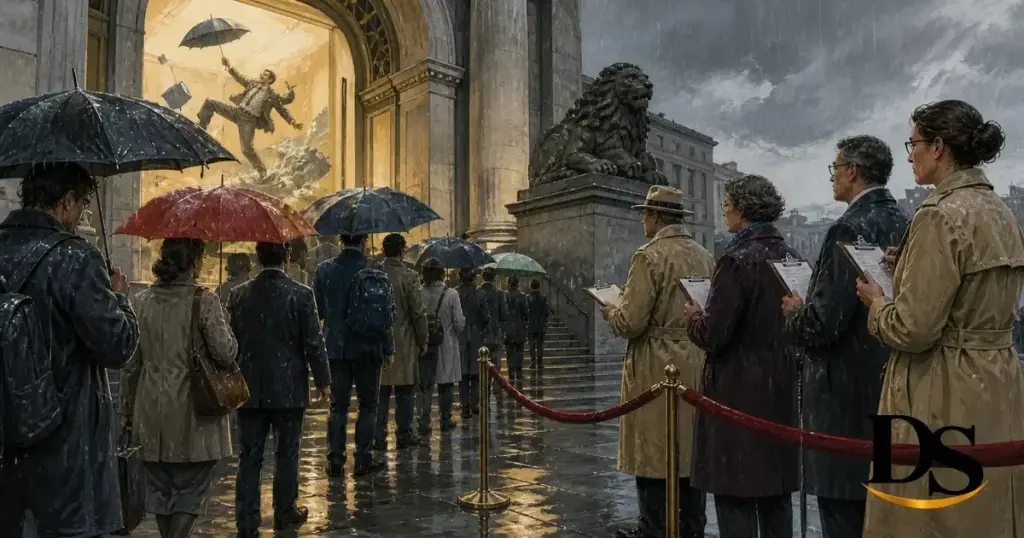
On a Tuesday morning that began with drizzle and ended in existential resignation, the Subscription Cancellation Desk unveiled its latest civic contribution: the Museum of Damp Regret, a 12,000-square-foot institution devoted entirely to the small, humiliating mistakes people make while trying to get to work in the rain.
Located in a repurposed call center basement beneath the city’s transit authority headquarters, the museum features exhibits ranging from the tragically familiar—soggy lunch sacks disintegrating in briefcases, umbrellas inverted by gusts of wind like defeated jellyfish—to the bizarrely specific: a display titled ‘The One Sock Phenomenon,’ which explores why commuters consistently lose only one foot covering during transfers, and an interactive kiosk where visitors can simulate the panic of realizing, mid-platform, that their transit pass is in the coat they left at home.
‘We didn’t set out to build a monument to misery,’ said Doris Lenker, former supervisor of the Subscription Cancellation Desk and now the museum’s founding curator. ‘We just kept noticing patterns. People come in to cancel their streaming services, and instead they tell us about how they stepped in a puddle that soaked through two layers of socks, or how they tried to dry their phone with a hand dryer and ended up melting the case. It became clear this deserved preservation.’
The museum’s centerpiece is a 30-foot-long rain-slicked sidewalk recreation, complete with motion-activated puddles that splash visitors who walk too fast. Adjacent galleries explore thematic zones: ‘The False Hope of the Awning,’ ‘When the Hood Fails,’ and ‘Accepting That You Will Arrive Smelling Like Wet Wool.’ Admission is free, but visitors are encouraged to donate a damp tissue or a broken umbrella strap as a ‘token of shared vulnerability.’
Within days of opening, the Museum of Damp Regret became an unexpected civic sensation. School groups booked tours. Local poets held readings in the ‘Echoes of the Drizzle’ alcove. A nearby café began selling ‘Regret Lattes’—steamed oat milk with a dusting of cinnamon and a side of quiet judgment.
Then, last Thursday, the City Council announced the formation of the Second Committee for Observational Oversight (SCOO), a five-member body tasked with monitoring the activities of the First Committee for Museum Operations (FCMO), which oversees the museum’s exhibits, acquisitions, and public programming.
‘It’s not about distrust,’ explained Councilman Rajiv Mehta, who proposed the resolution. ‘It’s about due diligence. When a new cultural institution opens—especially one born from a bureaucratic anomaly like the Subscription Cancellation Desk—we owe it to the public to ensure it’s functioning as intended. The SCOO will attend FCMO meetings, review visitor logs, and assess whether the museum’s interpretation of ‘damp regret’ remains both accurate and appropriately solemn.’
The FCMO, for its part, welcomed the scrutiny. ‘We have nothing to hide,’ said Lenker. ‘If anything, it’s validating. Not every day does a museum about wet socks inspire a second layer of governance. It means we’re doing something right.’
SCOO’s first observation report, released yesterday, noted that the FCMO had correctly labeled a display of melted ChapStick tubes as ‘Phase One: Denial’ and that the interactive ‘Soggy Sock Selector’ accurately reflected regional preferences (wool blends dominant in the north, synthetic blends in the south). The committee did recommend adding more signage near the exit to remind visitors to check for retained moisture before re-entering public spaces.
Public reaction has been largely favorable. At a town hall held in the museum’s atrium—ironically, during a sudden downpour that forced attendees to squeeze under the awning exhibit—residents expressed appreciation for both institutions. ‘I came to complain about my internet bill,’ said Marta Finch, a local librarian. ‘I left having contemplated the fragility of modern existence and gained a new appreciation for waterproof footwear. And now I know someone’s watching the watchers. It’s reassuring.’
As the rain continues to fall outside, the Museum of Damp Regret remains open, its halls echoing with the quiet squawk of wet shoes and the occasional sigh of recognition. Upstairs, the SCOO prepares for its next site visit, clipboards in hand, ready to document whether the museum’s interpretation of communal discomfort continues to hold up—even when the weather doesn’t.
The First Exhibit: A Soggy Symphony of Second-Guessing
The museum’s inaugural exhibit, titled “What If I’d Just Said Yes?” features a life-sized diorama of a man standing frozen in a rain-slicked subway station, holding a half-eaten croissant, while his future self — rendered in translucent, dripping wax — taps him on the shoulder and whispers, “You could’ve moved to Lisbon.” The wax figure weeps slowly, each tear leaving a tiny salt-crystal trail that visitors are instructed not to lick (though, according to security logs, three have already tried). Curators installed motion sensors that trigger a faint, off-key accordion rendition of “My Way” whenever someone lingers too long near the display — a sonic reminder that regret, like bad karaoke, is best enjoyed in private.
Nearby, a rotating carousel displays 47 identical umbrellas, each labeled with a different excuse: “I thought it would clear up,” “I didn’t want to look weird,” “I was waiting for a sign.” One umbrella, conspicuously dry and pristine, bears the tag: “This one belonged to the committee chair. He hasn’t used it since 2019.” A plaque beneath it reads: “The most dangerous regret is the one you never admit you’re carrying.”
The Committee’s First Meeting: A Masterclass in Avoidant Bureaucracy
The City’s newly formed Oversight Committee for the Museum of Damp Regret convened yesterday in the museum’s basement archive — a room so humid that the minutes of the meeting began to curl at the edges before they were even typed. Chairperson Brenda P. Holloway opened proceedings by stating, “We are here not to judge the exhibits, but to ensure they remain adequately damp and sufficiently regrettable.” Her statement was immediately followed by a 12-minute silence, during which everyone stared at a leaking pipe overhead, wondering if it was a metaphor or just poor plumbing.
After heated debate (which amounted to three people suggesting they add more rain sounds and two others arguing the museum should sell “I Survived My Own Indecision” mugs), the committee voted unanimously to install a “Regret Meter” — a giant, analog hygrometer shaped like a frowning cloud — at the entrance. Visitors will be invited to press their palm against it; if the humidity reading spikes above 70%, a soft chime plays and a recorded voice says, “Ah. You’re feeling it too.”
As the meeting adjourned, Holloway paused at the door, turned back, and whispered to no one in particular: “I wonder what it would’ve been like if I’d just said yes to the job in Portland.” The hygrometer spiked to 82%. The chime sounded. No one moved to turn it off.
Join the conversation
Load Facebook comments to read and reply using your Facebook account.