
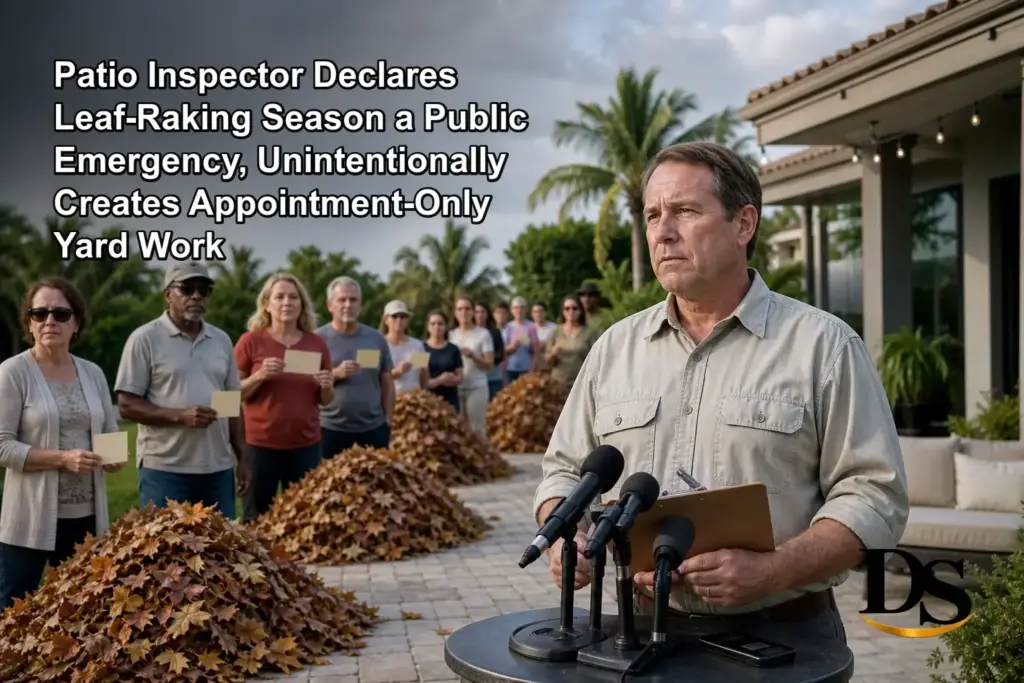
ORLANDO, Fla. — Standing before a bank of microphones under a drizzling autumn sky, Marion County’s Senior Patio and Exterior Structures Inspector, Dale Hemlock, cleared his throat and declared a state of ‘peak leaf-raking optimism’ — a term he insisted was not metaphorical.
‘We are at a tipping point,’ Hemlock said, gesturing toward a pile of damp oak leaves behind him that had accumulated over three days. ‘If we do not act now, the structural integrity of residential patios, walkways, and drainage grates will be compromised by organic slurry buildup. This is not about aesthetics. This is about load-bearing safety.’
What began as a routine seasonal briefing on exterior maintenance readiness quickly escalated when Hemlock, citing a 2019 municipal code amendment rarely enforced since the Great Irrigation Confusion of ’21, urged residents to ‘prioritize immediate, coordinated leaf removal’ to prevent ‘cascading hydrostatic failure’ in suburban hardscapes.
‘I’m not asking you to rake,’ Hemlock clarified, adjusting his reflective vest. ‘I’m telling you that if your patio’s pitch is less than 2 percent and your leaf depth exceeds four inches, you are in violation of Section 7.4(b) of the Residential Exterior Integrity Ordinance — and you will be cited.’
The statement, delivered with the gravitas of a hurricane warning, triggered an immediate surge of activity. By noon, hardware stores reported sold-out inventories of rakes, leaf blowers, and biodegradable bags. Neighborhood WhatsApp groups erupted with color-coded spreadsheets assigning raking zones by street and household.
But the situation took an unexpected turn when Hemlock, attempting to manage the influx of concerned citizens, announced an emergency measure: all patio inspections related to leaf accumulation would henceforth be conducted ‘by appointment only.’
‘We cannot have every resident showing up at the Annex with a ziplock bag of leaves and a tape measure,’ he explained. ‘It’s creating a bottleneck at Permit Counter 3. Appointments ensure fair access and proper documentation.’
What Hemlock framed as a logistical necessity was swiftly interpreted by the public as a new requirement: to rake your leaves, you first needed an appointment with the Patio Inspector’s Office.
‘I thought I was helping,’ Hemlock said later, when reached for comment. ‘I didn’t realize people would start calling to schedule their Tuesday morning leaf session like it was a dentist visit.’
By Thursday, the online booking system for ‘Exterior Hazard Assessments’ — a portal normally used for deck load testing and railing code consultations — had crashed under the weight of 14,000 attempted appointments. Users reported error messages ranging from ‘Leaf Density Too High for Same-Day Slot’ to ‘Your Rake Is Not Calibrated.’
Local satirists began posting mock confirmation emails: ‘Your appointment for Leaf Mitigation Consultation is confirmed for Friday at 2:15 PM. Please bring your own tarp and a signed affidavit of leaf origin.’ Others shared photos of residents sitting in folding chairs on their lawns, waiting for their numbered turn to rake.
Reactions were mixed. Retiree Gladys Perrine of Winter Park said she appreciated the structure. ‘I’ve been raking since ’78. It’s nice to finally have a system.’ Meanwhile, teens in Oviedo reported forming a leaf-raking gig economy, offering ‘expedited slot clearance’ for $20 a bag.
City officials, meanwhile, scrambled to clarify. A spokesperson for Marion County Public Works emphasized that no new ordinance had been passed, and that Hemlock’s comments were ‘interpretive guidance’ based on existing safety codes.
‘We do not require appointments to rake your yard,’ the spokesperson said. ‘We require inspections only if there’s a reported hazard — like a patio sinking because someone buried their hydrangeas under six inches of wet maple.’
Hemlock, for his part, maintains he was misunderstood. ‘I said “appointment-only inspections,” not “appointment-only raking.” There’s a difference. One is bureaucratic. The other is… well, still bureaucratic, but at least it keeps people off my lawn.’
As of Friday morning, the booking system remained active, though traffic had slowed. Some residents continue to show up with leaf samples and questions about compaction ratios. Others have simply resumed raking — without asking permission — and left polite notes on the inspector’s door: ‘Thanks for the concern. We’ve got it.’
The episode has become a local legend, cited in neighborhood association meetings as a cautionary tale about the perils of precise language in public safety messaging. Hemlock, meanwhile, has begun drafting a follow-up statement on ‘peak gutter-clearing vigilance,’ scheduled for release after the first frost.
Leaf Rationing and the Rise of the Yardwork Black Market
Within 48 hours of the emergency declaration, suburban cul-de-sacs began to resemble war zones of passive-aggressive turf management. Homeowners, barred from raking without a city-issued permit, turned to clandestine leaf disposal. Underground ‘yardwork whisperers’ emerged — retired landscapers offering off-the-books mulching services for cash, cryptocurrency, or homemade zucchini bread. One anonymous source, speaking from behind a strategically placed potted fern, revealed a thriving barter economy: ‘I traded three hours of leaf blowing for a jar of pickled beets and a promise not to tell the HOA.’ Meanwhile, hardware stores reported a 300% spike in sales of leaf blowers disguised as ‘holiday décor inflators’ and rakes marketed as ‘modern art sculpture tools.’ The city, overwhelmed by permit requests, outsourced approvals to a third-party app called ‘LeafLet,’ which crashed repeatedly under the weight of 12,000 simultaneous users trying to schedule a 15-minute raking window between 7:03 and 7:18 a.m. on a Tuesday.
The Commissioner’s Climactic Concession
Just as tensions peaked — with a neighborhood association threatening to secede and form the Independent Republic of Lawn Order — Commissioner Doris T. Leafbeam appeared on local access television, wearing a cardigan embroidered with tiny, trembling leaves. In a moment of uncharacteristic vulnerability, she admitted she’d declared the emergency not out of bureaucratic zeal, but because she’d lost a bet to her book club over who could predict the first frost. ‘I thought if I made it official, nobody would question why I was measuring leaf depth with a ruler,’ she confessed, voice cracking. ‘Turns out, everyone noticed.’ She then announced the immediate suspension of the permit system, replacing it with a voluntary ‘Leaf Honor Code’ — complete with printable badges and a pledge to ‘rake with joy, not obligation.’ As the camera panned out, a neighbor silently slipped a five-dollar bill into her hand and whispered, ‘For the zucchini bread.’ The screen faded to black, and for the first time in weeks, the only sound was the distant, peaceful rustle of leaves deciding, on their own terms, where to land.
Join the conversation
Load Facebook comments to read and reply using your Facebook account.