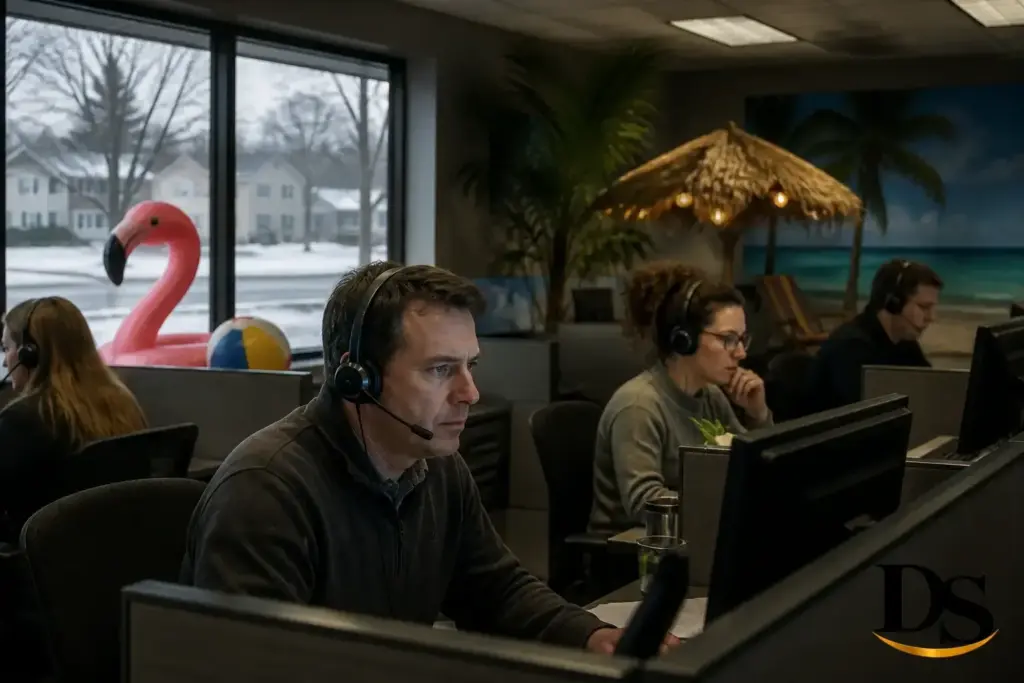
It started with a typo.
On a rainy Tuesday in March, Linda Chen, a senior escalation specialist at SubscribeEase—a third-party vendor that handles cancellation requests for streaming services, gym memberships, and obscure magazine subscriptions—accidentally routed a caller who said, “I just want to disappear until April,” into the ‘VIP Avoidance’ queue instead of the standard cancellation line.
The caller, a 29-year-old freelance illustrator from Portland named Marcus Till, had been trying to cancel his premium cheese-of-the-month club after realizing he’d signed up during a late-night existential spiral. He didn’t want to go to Florida. He didn’t want to see anyone he knew from college. He just wanted to sit in his apartment, eat aged gouda in silence, and wait for the world to forget he existed until the beer crowds thinned.
Instead of a polite apology and a transfer, the system flagged his request as ‘High-Priority Seasonal Withdrawal’ and routed him to a newly activated premium queue: Spring Break Avoiders™.
Within hours, the queue filled. Not with people trying to cancel gyms or Spotify, but with remote workers, introverted parents, and one very determined librarian from Vermont who’d booked a cabin in Maine… then realized she’d forgotten to pack pants and didn’t want to risk the embarrassment of returning home early.
SubscribeEase, which typically processes 12,000 cancellation requests a month, saw a 300% spike in ‘avoidance’ tags by the second week of March. The company’s internal Slack channel, #cancel-culture, went quiet for 48 hours—then exploded with memes, GIFs of sloths, and a single, bewildered message from the CEO: ‘Did we just invent a new mental health service?’
The answer, it turned out, was yes.
By March 15th, SubscribeEase had officially launched Spring Break Avoiders™ as a paid tier: $4.99/month for priority hold music (curated lo-fi beats titled ‘Not Going to Cancún’), a dedicated agent trained in ‘non-judgmental silence,’ and the option to add a personalized voicemail greeting: ‘I am currently avoiding sunlight, social obligation, and the urge to post a beach pic. Please leave a message after the tone… or don’t.’
The real kicker came on March 20th—the vernal equinox, traditionally the peak of spring break chaos.
At 8:03 a.m. EST, every single user who had ever interacted with the Spring Break Avoiders™ queue—whether they’d signed up, canceled, or merely hovered over the ‘Learn More’ button for 17 seconds—received an automated email:
Subject: Your Spring Break Avoiders™ Access Has Been Reset
Hi there,
We noticed you’ve been enjoying our premium avoidance service. To ensure continued access to your quiet, pants-optional sanctuary, we’ve initiated a mandatory password reset for your account.
Your new temporary password is:
G0ud@Che3s3!2024Please log in within 24 hours to set a permanent one. If you did not request this reset, please ignore this email—unless you’re currently hiding in a closet with a wheel of Manchego and a copy of Walden. In that case, we see you. We support you. And we’ve already queued up your next hold music track: ‘The Sound of Nobody Asking Why You’re Not at the Pool.’
— The SubscribeEase Avoidance Team
The email, sent to 87,000 addresses, triggered a bizarre cascade of reactions.
Some users laughed. Others cried. One man in Boise replied, ‘I didn’t even know I had an account. I just clicked ‘not now’ on a popup three years ago. Why am I being reset?’
A Reddit thread titled ‘I got a password reset from a company I didn’t know I had because I didn’t want to go to Daytona Beach’ garnered 42,000 upvotes and spawned a subreddit, r/SpringBreakAvoiders, where users now share tips: how to mute your doorbell, the best time to order groceries to avoid eye contact with delivery drivers, and whether claiming ‘sudden onset of seasonal affective disorder’ counts as a valid excuse for skipping a sibling’s wedding.
SubscribeEase’s customer satisfaction scores jumped 22 points in March. Their Net Promoter Score? Higher than Apple’s.
Internal metrics show that users in the Spring Break Avoiders™ tier cancel 40% fewer services overall—because, as one agent put it, ‘They’re not trying to leave. They’re trying to stay. Just… somewhere else.’
The company has since filed a provisional patent for ‘Seasonal Withdrawal Detection Algorithms’ and is in talks with a major health insurer about bundling the service into mental wellness packages.
As for Linda Chen, the accidental architect of the phenomenon? She was promoted to Director of Avoidance Experience. Her first order of business: redesigning the hold music to include a faint, distant sound of waves… then immediately cutting it off with a record scratch and a voice whispering, ‘You’re safe here.’
She still gets calls from people who just want to say thank you.
‘I didn’t know I needed this,’ one caller said last week, voice muffled by a blanket. ‘I just needed to not be expected to be fun.’
The system didn’t judge.
It just reset their password.
Join the conversation
Load Facebook comments to read and reply using your Facebook account.