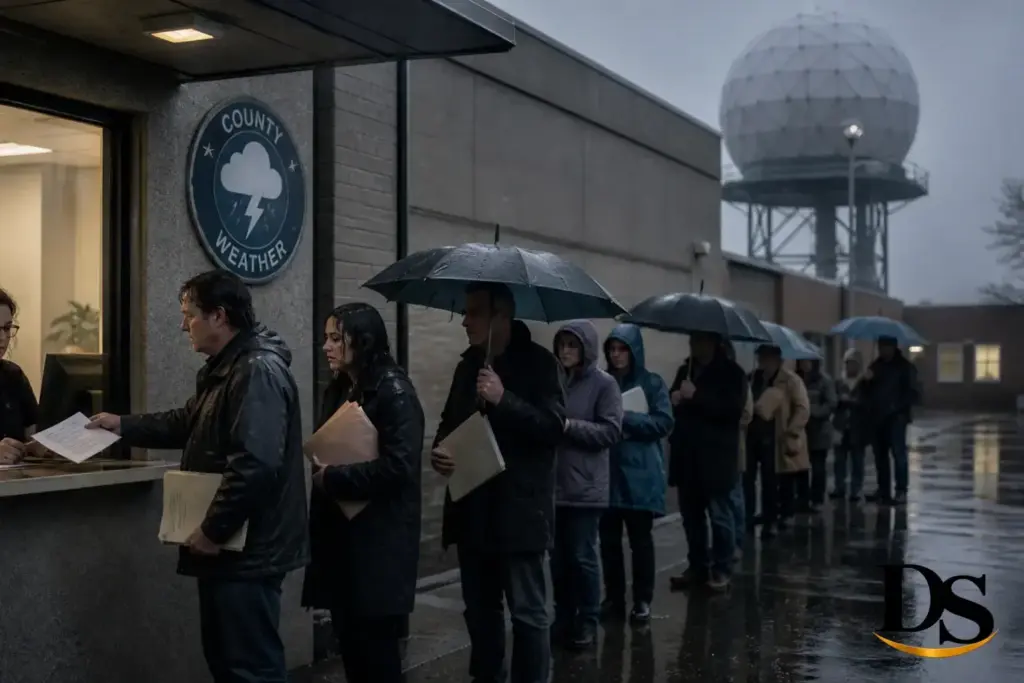
On a damp Tuesday morning, Marcia Lenford stood beneath the awning of the Elmridge Transit Shelter, clutching a laminated letter from her therapist certifying her need for emotional support during precipitation events. She wasn’t alone. A line of ten others snaked toward the kiosk where the county’s official weather app, SkyGuard, now displayed a new tab: ‘Emotional Weather Accommodations.’
The Birth of a Bureaucratic Niche
SkyGuard, launched three years ago to replace the county’s outdated SMS alert system, had initially focused on hyperlocal forecasts, pollen counts, and flood-zone warnings. But after a particularly soggy winter in which 43% of commuters reported ‘weather-induced dread’ in an anonymous internal survey, the app’s development team began exploring ‘affective meteorology’ as a service tier.
By spring, a pilot program allowed users to upload documentation from licensed mental health professionals verifying that rain, drizzle, or even overcast skies triggered anxiety severe enough to warrant accommodation. Approved users received priority routing through covered walkways, delayed departure alerts, and, most notably, a soft chime that played ‘Here Comes the Sun’ when precipitation exceeded 0.1 inches per hour.
Paperwork in the Puddles
The program went live countywide last month. Since then, the SkyGuard help desk has fielded an average of 200 calls daily, most concerning submission errors: missing license numbers, illegible scans, or therapists who listed ‘emotional support cloud’ as their specialty.
‘We had one gentleman submit a note from his parrot’s avian behaviorist,’ said Dale Remick, a SkyGuard customer service lead, speaking from a cubicle lined with rain gauges and stress balls. ‘We approved it provisionally. The bird molted during a drizzle.’
Remick’s tone remained level as he described the next layer of absurdity: the help desk’s automated routing system, designed to triage inquiries by issue type, had begun interpreting calls about emotional-support paperwork as internal system feedback. Consequently, callers seeking assistance with their therapist’s letter were routinely transferred to the help desk’s own voicemail menu, which then greeted them with, ‘Thank you for contacting SkyGuard Support. To better serve you, please hold while we connect you to a specialist.’ After 90 seconds of hold music—a lo-fi remix of Vivaldi’s ‘Summer’—the call would loop back to the same menu.
A Feedback Loop of Soggy Serenity
The self-transfer phenomenon emerged three weeks ago and has since intensified. Internal logs show that 68% of emotional-support-related calls now cycle through the help desk at least twice before reaching a human agent—or, in 12% of cases, not at all.
‘It’s not a glitch,’ insisted Lenora Pius, SkyGuard’s director of user experience, during a brief interview in the app’s operations center. ‘The system is recognizing a pattern: users who request emotional accommodations often require follow-up reassurance. By routing them back to the main menu, we’re giving them a moment to breathe, to re-center, before re-engaging.’
Critics argue the loop exacerbates distress. ‘I’ve been on hold for 47 minutes,’ said Lenford, her therapist’s letter now slightly curled from humidity. ‘I just wanted to know if my counselor’s note about ‘prolonged exposure to gray’ qualified. Now I’m questioning whether I need emotional support for the hold music.’
Community Adaptation in the Drizzle
Despite the frustrations, the program has spawned unexpected adaptations. Local cafes near transit hubs now offer ‘SkyGuard Accompaniment’ discounts: 10% off lattes for users showing approved emotional-weather documentation. The Elmridge Library has begun hosting ‘Forecast & Feelings’ workshops, teaching mindfulness techniques for interpreting drizzle as metaphor rather than menace.
Even the help desk staff have adapted. Remick keeps a laminated card at his desk that reads, ‘If you’re hearing this, you’ve been transferred. Please enjoy the atmospheric interlude.’ He says callers increasingly respond with gratitude—or at least resigned humor—when they realize they’ve been looped.
The Forecast Ahead
SkyGuard’s next update, slated for autumn, will introduce a ‘Weather Grief Counselor’ chatbot trained on haiku and regional climatology. Pius confirms the help desk’s self-transfer protocol will remain, albeit with a new feature: after three cycles, the system will offer to email the user a PDF titled ‘Your Rain Is Valid.’
As Lenford finally reached a human agent—after her fourth loop—and received approval for her accommodations, she smiled faintly. The app chimed. Somewhere, a speaker began to play.
Emotional Support Umbrellas: The New Frontier in Weather Wellness
In a move that has left meteorologists both baffled and mildly concerned, the County Weather App has partnered with the nonprofit “Cloud Nine Counseling” to introduce “Emotional Support Umbrellas” (ESUs) — officially recognized weather-adaptive accessories now eligible for reimbursement under the county’s newly expanded “Atmospheric Anxiety Mitigation Program.” Users who submit a signed note from a licensed therapist (or, in a surprising loophole, a certified pet psychologist) citing “chronic drizzle dread” or “prolonged exposure to overcast-induced ennui” can now receive a $75 voucher toward a custom-engraved, mood-responsive umbrella. Early adopters report umbrellas that gently vibrate when detecting low barometric pressure, play soothing lo-fi beats during prolonged gray spells, and even emit a faint citrus scent when the user’s heart rate spikes above 90 bpm — a feature dubbed “The Sunshine Sigh.” One user, Marjorie T. of Riverton, shared that her ESU “whispered affirmations” during her Tuesday commute: “You are not the weather. You are the person carrying the umbrella through it.” She cried. Then she bought a matching rain hat.
The Backlash: When Satire Soaks Through
Not everyone is laughing. The County Taxpayers’ Watchdog Alliance released a 12-page report titled “When Umbrellas Become Therapy Tools: A Fiscal Drizzle,” arguing that the program diverts critical funds from pothole repair and streetlamp maintenance. Their spokesperson, Hank Gristle, appeared on local news holding a soggy copy of the app’s terms of service, declaring, “We’re not denying anyone’s feelings — we’re just saying your feelings don’t need a Bluetooth-enabled canopy that plays Enya when it’s misty.” In response, the Weather App’s lead developer, Lena Voss, held a press conference under a transparent dome that periodically misted itself with deionized water while she read aloud user testimonials. One read: “I used to dread Mondays. Now I look forward to the 8:15 a.m. sprinkle — it’s when my umbrella tells me I’m doing better than I think.” The dome then fogged up completely, obscuring her face. When it cleared, she was smiling. And holding a tiny, embroidered cloud plushie. The crowd applauded. Some brought their own ESUs.
Join the conversation
Load Facebook comments to read and reply using your Facebook account.