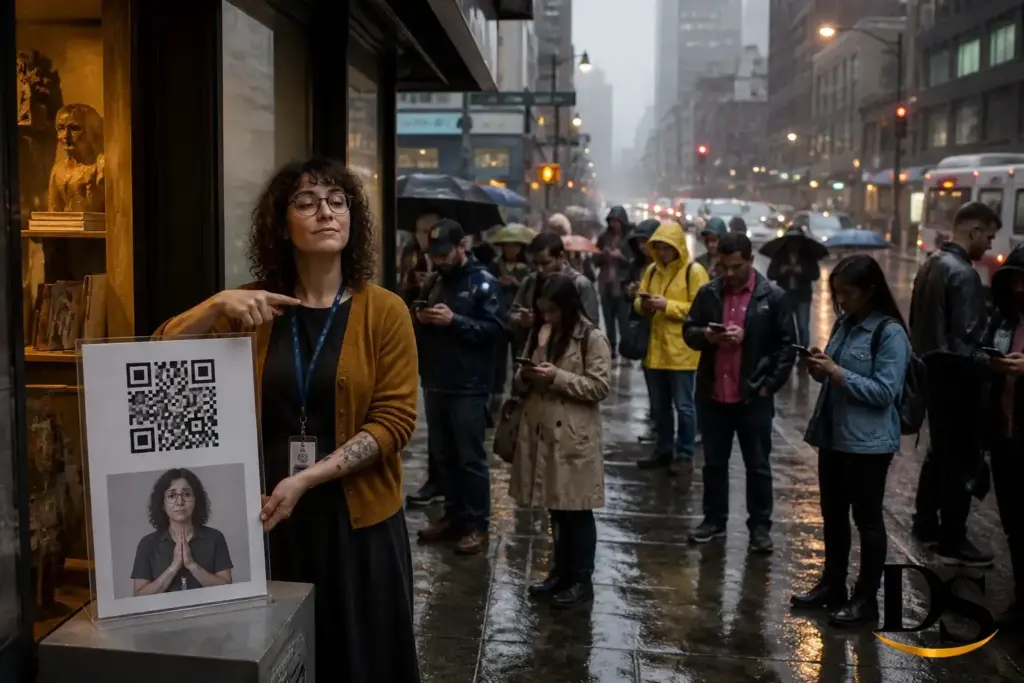
On a Tuesday morning when the sky opened like a forgotten faucet, Elara Voss, curator of the Municipal Museum of Minor Arts’ gift shop, stood beneath the awning of the 5th and Elm transit hub, clutching a laminated sign that read: ‘Scan to Delay Your Commute — Bipartisan Commission Approved.’
The idea had come to her during a slow Tuesday inventory of novelty paperweights shaped like endangered marsupials. With the city’s new ‘Civic Pause Initiative’ encouraging citizens to ‘micro-delay’ non-essential movement during extreme weather, Voss saw an opportunity. She’d convened a unofficial commission — two retired librarians, a barista who ran for school board in 2018, and a part-time mime who identified as politically unaffiliated — to endorse a QR code that would, in theory, link to a live feed of calming museum exhibits: a slow-motion jellyfish tank, a time-lapse of dust settling on a 17th-century globe, the occasional sigh of a security guard.
‘We weren’t trying to stop the rain,’ Voss explained later, her voice calm despite the drizzle seeping into her cardigan. ‘We were trying to stop the rush. If people just waited five minutes, the worst of it might pass. It’s civic mindfulness.’
The sign went up at 8:03 a.m. By 8:07, the first commuter scanned. Then another. By 8:15, a slow-moving queue had formed under the awning, umbrellas lowered, phones glowing. The QR code, printed on recycled cardstock and laminated with museum-grade poultice, was designed to last. It linked, Voss insisted, to a serene loop of the museum’s ‘Whispering Archives’ exhibit.
What appeared instead was a grainy, 47-second video from October 12, 2019: Mayor Dolores Chen, standing before a backdrop of faded bunting, apologizing for the ‘unfortunate timing’ of the annual Pickle Festival parade, which had coincided with a citywide transit strike. ‘I sincerely regret any inconvenience caused to those attempting to reach their places of employment, worship, or quiet contemplation,’ she said, adjusting her glasses. ‘The brine was not worth the blockage.’
The video had been archived on the city’s outdated server, buried under a mislabeled folder titled ‘Public Relations – Misc – Do Not Delete (Possibly Funny).’ Someone, years ago, had accidentally set it as the default redirect for a defunct tourism kiosk QR code. Voss, unaware, had reused the same short URL generator when creating her commission’s sign.
‘I thought it was the jellyfish,’ said Rajiv Mehta, a software engineer who scanned the code twice, convinced he’d missed something. ‘I waited for the tentacles. All I got was the mayor and a lot of dill.’
By 9:00 a.m., the crowd had swelled to nearly two hundred. No one moved. Some pulled out chairs from nearby cafes. A ukulele player began a soft rendition of ‘Here Comes the Sun.’ A debate erupted over whether the apology constituted valid grounds for a civic pause under Initiative 7-B. The retired librarians cited parliamentary precedent. The mime performed a silent sketch titled ‘The Weight of Regret.’ The barista handed out free samples of oat milk latte, declaring it ‘solidarity foam.’
City officials, alerted by a traffic cam showing unprecedented stillness at the intersection, arrived cautiously. Deputy Director of Transit Mira Ng knelt beside Voss and peered at the laminated sign.
‘This,’ Ng said slowly, ‘is not in the initiative handbook.’
Voss nodded. ‘No. But it’s working.’
After 47 seconds — the exact length of the video — the loop restarted. And again. And again. By 10:30, the rain had eased to a drizzle. The crowd, now murmuring politely, began to disperse. No one complained. Several asked for copies of the QR code. One woman requested a printout of the mayor’s apology to frame.
By noon, the sign was taken down. The QR code was retired. The bipartisan commission, now officially recognized by the museum’s board as the ‘Committee for Temporal Civility,’ voted to reconvene only if the rain exceeded 0.8 inches per hour and the museum’s humidor needed recalibration.
As for Mayor Chen, she learned of the incident via a forwarded clip from her nephew. She did not comment publicly. But sources close to her office confirmed she had, for the first time in five years, rewatched the apology video — and smiled.
Commuters Turn Frustration into Art, One QR Scan at a Time
What began as a minor inconvenience—a misplaced QR code sticker affixed to a bus shelter near Union Station—has evolved into an unexpected grassroots art project. By Tuesday afternoon, over 200 commuters had paused mid-stride to scan the stubborn code, each greeted not with a transit update or municipal apology, but with a single-panel comic by the elusive street artist known only as ‘Smirk.’ The latest installment, revealed only after the third scan (a deliberate anti-bot measure, according to Smirk’s encrypted Instagram bio), depicted a soggy pigeon holding a tiny umbrella while judging a human in a trench coat who’d forgotten theirs. The caption, rendered in Smirk’s signature jagged sans-serif: ‘Apology pending. Patience: not waterproof.’
City officials, initially dismissive, have since acknowledged the stunt’s cultural resonance. Transit Authority spokesperson Lena Cho admitted in a press briefing that the QR code was part of a ‘pilot engagement initiative’ gone awry—meant to link to a delayed 2019 service apology video, but misrouted due to a typo in the URL field. ‘We meant to say “sorry4the delay,”’ Cho confessed, ‘not “sorry4theapology2019.” One letter. One number. A lifetime of wet socks.’
As rain intensified Thursday evening, the shelter’s QR code began to peel—but not before a retired calligrapher laminated it with clear tape and left a handwritten note: ‘Keep scanning. We’re still waiting.’ Below it, someone had sketched a tiny heart around the pigeon’s umbrella. The code remains active. The apology, still pending. And somewhere, Smirk is already drafting Panel Four.
The Apology That Wasn’t: A Meta-Comic Unfolds in Real Time
By Friday morning, the QR code had migrated—digitally, at least. A Reddit thread r/CitySmirk exploded with user-generated variants: one showed the pigeon suing the city for emotional distress; another depicted the 2019 apology video as a VHS tape being eaten by a raccoon. Smirk, meanwhile, uploaded a new layer to the code: a hidden frame accessible only after scanning seven times in rapid succession. It revealed a mock ‘Director’s Cut’ of the nonexistent 2019 apology—featuring a CGI mayor in a raincoat, sighing, ‘I’m sorry for the rain. I’m sorry you believed me. I’m sorry this took five years.’ The audio? A single, looping kazoo rendition of ‘Raindrops Keep Fallin’ on My Head.’
The stunt has now inspired similar QR-based micro-comics in three other cities, each tying local transit failures to absurdist punchlines. Yet here, the original shelter remains a pilgrimage site. On Saturday, a florist left a bouquet of daffodils beside the code—wet, but defiant. A teenager taped a sign to the pole: ‘This is not a glitch. This is graffiti with grace.’
As the clouds finally broke Monday morning, the QR code glistened under weak sunlight. One last commuter paused, scanned, and smiled at the final panel: the pigeon, now wearing sunglasses, tossing the umbrella into a trash can labeled ‘2019.’ Below it, in Smirk’s unmistakable script: ‘Apology accepted. Now go buy yourself a coffee. You’ve earned it.’ The code then redirected to a live feed of a nearby café’s espresso machine. Steam rose. The city exhaled.
Join the conversation
Load Facebook comments to read and reply using your Facebook account.