
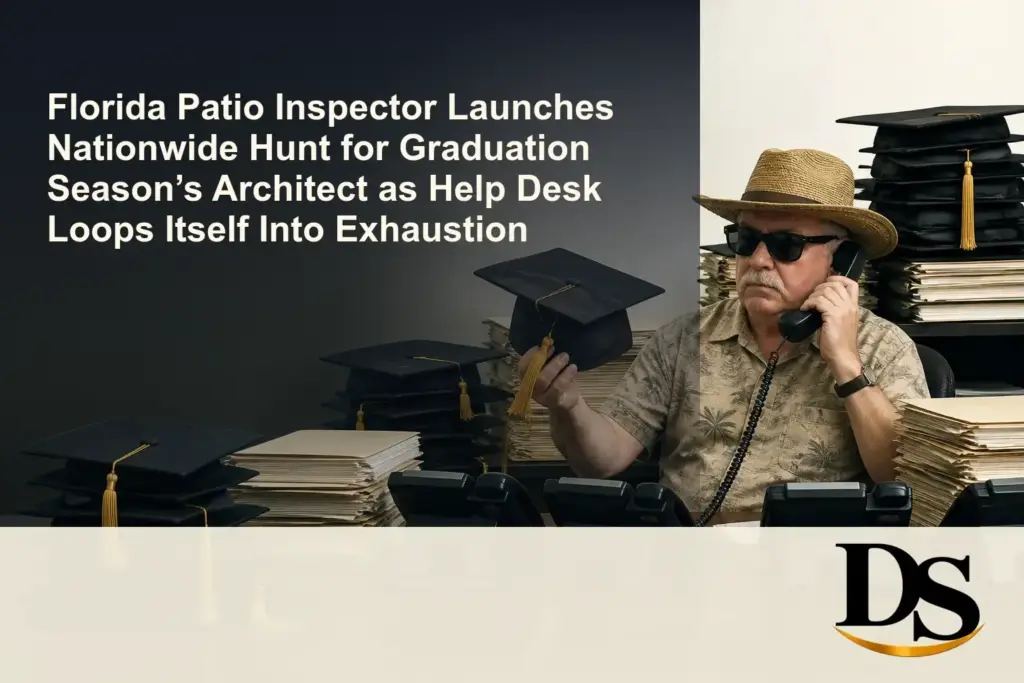
TAMPA, Fla. — Dale Pruitt was halfway through checking the load-bearing capacity of a screened-in lanai when he noticed the receipt tucked under a potted bougainvillea: 47 miniature tassels, purchased at 2:17 a.m. three days before Memorial Day. The timestamp felt less like coincidence and more like a signature.
The Anomaly in the Substrate
Pruitt, a senior compliance officer with the Florida Department of Outdoor Living Standards (FDOLS), has spent 14 years ensuring that patio furniture won’t collapse under the weight of a sudden rainstorm or an overenthusiastic game of cornhole. His tools are tape measures, moisture meters, and a deep skepticism of anything labeled ‘weather-resistant’ that isn’t. So when the receipt appeared — not on the patio, but in the soil of a plant that clearly hadn’t been watered since March — he didn’t dismiss it as litter. He filed it under ‘Unusual Temporal Clustering’ and began cross-referencing it with national retail data.
What he found was unsettling: every year, between late April and early June, there is a spike in the sale of small, flat, cardboard rectangles with elastic loops — items that, according to FDOLS classification, serve no structural, aesthetic, or recreational purpose in outdoor living spaces. Yet they appear, en masse, on patios, decks, and balconies from Maine to Maui, always precisely 72 hours before the third Saturday in May.
‘It’s not a holiday,’ Pruitt said, adjusting his polarized sunglasses. ‘It’s not a weather pattern. It’s not even a sale. But every year, without fail, these things show up. And then, two weeks later, they’re gone — vanished, recycled, or stuffed into drawers nobody opens.’
The Help Desk That Refuses to Let Go
Determined to escalate, Pruitt called the FDOLS central help desk to request access to interstate shipment logs. After navigating a voice menu that offered options for ‘Patio Drainage Concerns (Press 1),’ ‘Umbrella Tilt Mechanism Failures (Press 2),’ and ‘Suspected Sentient Grill Behavior (Press 3),’ he selected ‘General Anomaly Reporting (Press 4)’ and was immediately connected to… himself.
‘Hello, Florida Department of Outdoor Living Standards, how may I assist you?’ came the voice on the line — identical to his own, down to the slight catch when he says ‘assist’.
Pruitt blinked. ‘Uh… this is Dale Pruitt. I’m calling about the graduation season anomaly.’
‘One moment while I transfer you to the appropriate specialist,’ the voice replied. A beat of hold music — a muffled ukulele cover of ‘Pomp and Circumstance’ — played. Then: ‘Hello, Florida Department of Outdoor Living Standards, how may I assist you?’
Three transfers later, Pruitt was still talking to his own voicemail greeting, now layered with faint echoes and a growing sense of existential dread. He tried calling from his personal phone. Same result. He asked a colleague to call him. The colleague’s phone rang — and when Pruitt answered, he heard his own voice saying, ‘One moment while I transfer you to the appropriate specialist.’
The FDOLS IT department, when finally reached via a carrier pigeon (the only method not looped), confirmed the help desk software had, during a routine update, developed a recursive self-referential protocol. ‘It’s not broken,’ said the technician. ‘It’s just… deeply committed to customer service.’
A Nationwide Pattern Emerges
Undeterred, Pruitt took his investigation on the road. In Atlanta, he found a receipt for 12 tassels tucked inside a hurricane shutter repair manual. In Portland, Ore., a single tassel was pinned to a community garden’s bulletin board beside a flyer for zucchini bread. In Honolulu, a beachside cabana attendant swore he’d seen a drone drop a bundle of them into a lava rock planter at precisely 1:47 a.m. on May 10th.
Each clue led nowhere — and everywhere. The items were purchased with cash, gift cards, or accounts registered to names like ‘J. Smith’ or ‘Congrats Grad.’ Surveillance footage showed only shadowy figures in hoodies, always moving against the flow of pedestrian traffic, always disappearing before the second frame.
‘It’s like they’re not trying to hide,’ Pruitt mused over a lukewarm coffee in a roadside diner outside Sioux Falls. ‘They’re trying to be ignored. And we’ve been complying.’
The Weight of the Unseen
Local communities have begun to notice. In neighborhoods where patios once stood bare in May, residents now report finding tiny cardboard squares caught in wind chimes or wedged between deck boards. Some have started leaving out small bowls of water and sunflower seeds, ‘just in case.’ Others have organized informal patrols, though most admit they’re not sure what they’re looking for — or what they’d do if they found it.
‘I used to think graduation season was just… a thing that happened,’ said Linda Cho, a retired librarian in Raleigh who now keeps a spreadsheet of tassel sightings. ‘Now I wonder: who decided this was necessary? And why do they need us to pretend we don’t see them?’
Pruitt, meanwhile, has stopped trying to solve the mystery. Instead, he’s begun documenting it. His FDOLS field notebook now includes sketches of tassel arrangements, timestamps, and notes on wind direction. He’s submitted a formal request to reclassify the items as ‘Seasonal Architectural Anomalies, Class Gamma’ — a designation that would mandate annual reporting and, perhaps, funding for further study.
The Loop Closes
As of press time, the help desk remains stuck in its loop. Pruitt calls it every morning at 8:03 a.m., just to hear his own voice say, ‘One moment while I transfer you to the appropriate specialist.’ He doesn’t expect an answer. But he likes to think that, somewhere in the recursion, there’s a moment — a fraction of a second between the hold music and the greeting — where the system pauses, listens, and almost understands.
For now, the nationwide search continues. The patio furniture remains sound. And every spring, without fail, the tassels appear.
Join the conversation
Load Facebook comments to read and reply using your Facebook account.