
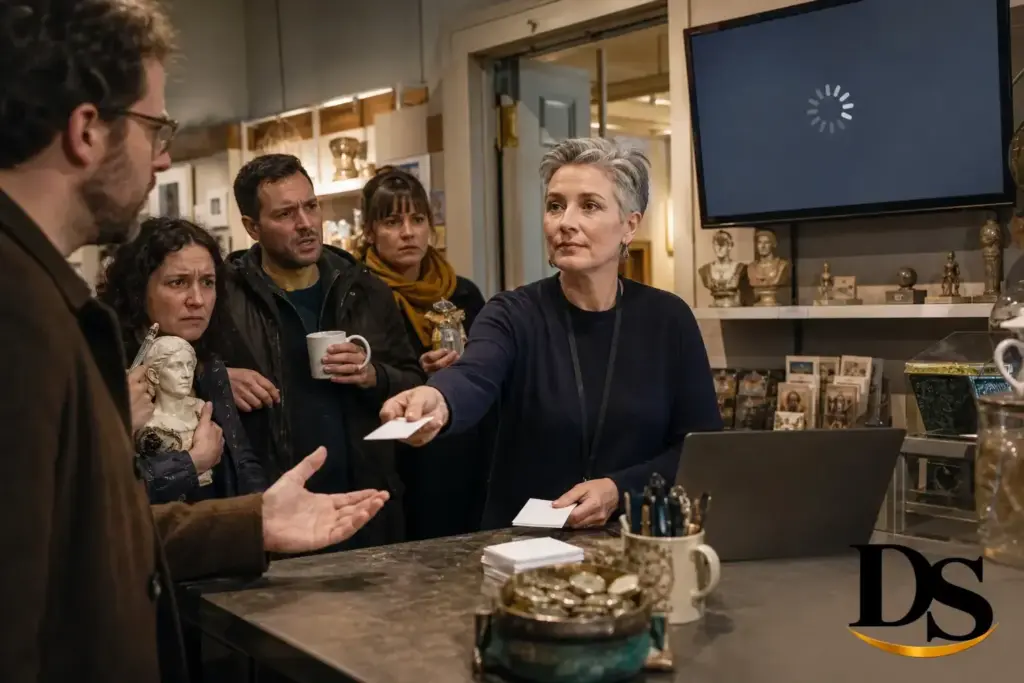
At precisely 8:47 p.m., the livestream of the presidential debate stalled on a split-screen shot of two candidates blinking in synchronized confusion. The buffering icon—three lazy dots circling a void—became the nation’s collective sigh. In the back corner of the Museum of Everyday Ephemera, gift-shop curator Lenora Vale looked up from restocking ceramic badgers and felt the weight of the moment.
The Birth of the Buffer Waiver
It started with a woman in a faded campaign button sobbing into a reusable tote bag. ‘I just needed to see if he’d answer the question about the corn subsidies,’ she whispered, voice raw. Lenora, who had spent the last decade arranging vintage lunchboxes and discontinued Pez dispensers by thematic melancholy, handed her a laminated card stamped with the museum’s seal: Official Emotional-Support Acknowledgement for Livestream Delay (OESALD). No fee. No questions. Just a quiet ‘take as needed’ and a single peppermint from the jar beside the register.
By 9:03 p.m., the line had grown to twelve. A retiree from Dubuque requested a waiver for ‘anticipatory dread.’ A college student in Brooklyn asked for one to cover ‘the existential vertigo of watching democracy glitch.’ Lenora, without breaking stride, began filling them out in neat cursive, adding the time, the nature of the distress (categorized as ‘ buffering-induced,’ ‘narrative suspension,’ or ‘unresolved policy anxiety’), and a small doodle in the corner—usually a badger wearing tiny headphones.
Institutional Drift
The museum’s director, Dr. Aris Thorne, initially objected. ‘We are not a crisis center,’ he said, adjusting his tie adorned with miniature compasses. But by 9:22 p.m., he was seen behind the counter, silently stamping waivers with a rubber stamp that read ‘Verified: The Buffer Holds’. The gift shop’s inventory shifted: stress balls shaped like ballot boxes flew off the shelves; ‘I Survived the Buffer’ pins, designed by Lenora’s intern, sold out in 17 minutes. Even the museum café began offering ‘Buffer Brew’—a chamomile latte with a side of silence.
Reactions from the Queue
‘It’s the only thing that made sense tonight,’ said Marcus Bell, a nurse from Atlanta, clutching his waiver like a talisman. ‘The candidates were talking past each other, the feed kept freezing, and suddenly I needed paperwork to validate that I was okay not being okay.’
Dr. Elise Moran, a media psychologist who happened to be visiting the museum’s exhibit on 20th-century communication breakdowns, observed: ‘What we’re witnessing is the ritualization of collective helplessness. In the absence of resolution, humans create symbols. A stamp. A card. A peppermint. It’s not absurd—it’s adaptive.’
By 10:15 p.m., the livestream resumed. The candidates, now wearing mismatched ties, resumed their debate over infrastructure. The buffering icon vanished. But the waivers kept coming. Lenora, now behind a makeshift desk of stacked exhibit catalogs, had issued 87. ‘People aren’t asking for fixes,’ she said, wiping her hands on her apron. ‘They’re asking to be seen in the pause.’
The Archive of Waiting
At closing, Lenora gathered the waivers into a translucent box labeled ‘OESALD: Election Night 2024’ and placed it on the shelf beside the collection of abandoned umbrellas from the 2008 inauguration and the single left glove from a 2016 victory parade. ‘This,’ she told Dr. Thorne, ‘is where we keep the moments the feed couldn’t.’
The museum plans to display the waivers next spring in an exhibit titled ‘The Quiet Between Signals’. No opening remarks are planned. Visitors will be invited to sit in silence for exactly three minutes—the average length of a national livestream buffer during peak emotional tension—and then leave with a peppermint, if they wish.
The Unlikely Rise of the Snack-Table Therapist
As the livestream’s buffering icon spun into its third hour, something strange began to happen in the gift shop corner of the community center: voters, eyes glazed from staring at frozen candidate faces, started drifting over not for the ‘I Voted’ stickers or the locally roasted coffee, but for the quiet, steady presence of Marjorie ‘Marge’ Pendergast, the shop’s curator and unofficial emotional triage nurse. She didn’t offer advice — she offered context. A woman in a ‘Vote Like Your Dog Depends On It’ tee sat down trembling after seeing a misleading ad; Marge slid over a warm ginger cookie and said, ‘That ad was made by a guy who thinks ‘gerrymandering’ is a new yoga pose. Breathe. You’re not crazy.’ A teenager, overwhelmed by the sheer volume of misinformation, confessed he didn’t know if his vote mattered. Marge handed him a hand-stamped button that read ‘I Voted (And I Survived Marge’s Cookie Intervention)’ and whispered, ‘It matters because you showed up. Even if the stream didn’t.’ The shop’s inventory shifted: the ‘I Survived Election Day’ mugs sold out by 4 p.m.; the ‘Buffering Is Not a Political Statement’ tote bags became a viral sensation on TikTok after a poll worker filmed a voter hugging one while crying-laughing. By 6 p.m., the gift table had become an impromptu sanctuary — complete with a handwritten sign: ‘No Hot Takes Allowed. Only Hot Tea, Honest Silence, and the Occasional Dad Joke.’ One man, still in his work coveralls, left a single dandelion on the counter with a note: ‘For the woman who didn’t fix the stream… but fixed me.’
The Buffering Breakthrough
Just as the polls closed and the final precincts began reporting, the livestream hiccuped — not with a freeze, but with a sudden, glitchy burst of audio: a child’s voice, clear as a bell, singing off-key: ‘I like the one with the hat! He looks like my grandpa!’ The feed stuttered again — then, miraculously, stabilized. The candidate on screen, mid-sentence about tax policy, paused. Looked directly into the camera. And smiled. Not a political smile. A real one. ‘You know,’ he said, voice softer now, ‘my granddaughter just told me I look like her grandpa. I think she’s right. And I think… we’re all just trying to get home.’ The buffering icon vanished. Not because the bandwidth improved — but because, for the first time all day, everyone watching stopped trying to decode the signal… and started listening to the silence between the beats. Marge, wiping her hands on her apron, turned off the shop lights. She didn’t need to say anything. The dandelion on the counter was still there. Tomorrow, she’d restock the cookies. But tonight, she knew: the real election wasn’t in the numbers. It was in the quiet, stubborn acts of showing up — for each other — when the stream failed, and we had to rely on something older, quieter, and far more reliable: each other.
Join the conversation
Load Facebook comments to read and reply using your Facebook account.