
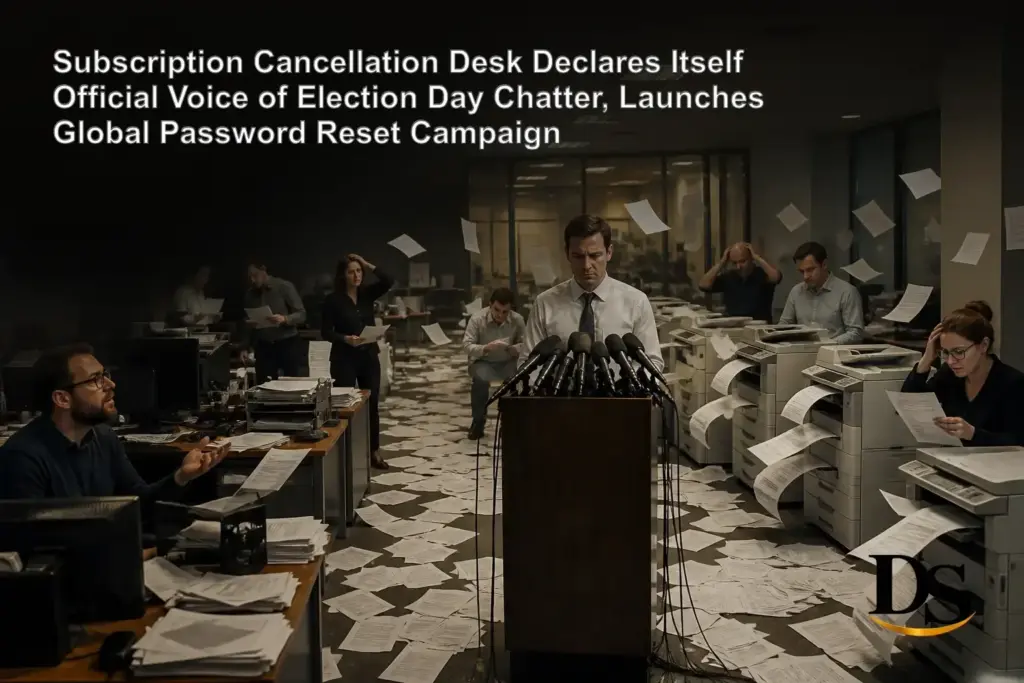
On the morning of November 5th, as voters across the globe queued at polling stations or refreshed live vote trackers, an unexpected communique began appearing in inboxes from Jakarta to Johannesburg. It came not from electoral commissions, news outlets, or social media platforms, but from a most unlikely authority: the Subscription Cancellation Desk of NexaServ Inc., a mid-tier SaaS provider headquartered in Dublin.
The Declaration
At precisely 8:17 a.m. GMT, the desk—staffed by three contractors and overseen by a shift manager named Lenore Voss—issued an internal memo that quickly escaped containment. Titled ‘Proclamation on Civic Discourse and Digital Stewardship,’ it asserted that, due to ‘widespread public confusion regarding subscription fatigue and democratic participation,’ the Cancellation Desk was hereby assuming ‘temporary stewardship of the national conversation’ on Election Day.
The memo, later leaked to tech blogs and picked up by regional radio stations, argued that voters were ‘overwhelmed by opt-out fatigue’ and deserved a ‘unified digital intervention’ to restore clarity. It concluded with a directive: ‘All users shall receive a password reset link by 10:00 a.m. local time, regardless of account status or recent activity.’
The Rollout
What followed was a logistical feat of awkward sincerity. NexaServ’s systems, designed to handle a few hundred cancellation requests per day, were rerouted to dispatch password reset emails to over 87 million dormant, active, and long-abandoned accounts. The emails, branded with the company’s muted teal logo, carried no political messaging—only a single button: ‘Reset Your Password.’
Recipients reacted with a mix of bewilderment, amusement, and mild alarm. In Oslo, a retired librarian forwarded the email to her book club with the subject line: ‘Is this a coup?’ In Buenos Aires, a cybersecurity student tweeted a screenshot with the caption: ‘The Cancellation Desk has more influence than the Electoral Tribunal.’
NexaServ’s public relations team, caught off-guard, initially denied the memo’s authenticity. But after internal Slack logs were shared with fact-checkers, CEO Elena Mireau confirmed the desk had acted ‘unilaterally but with sincere intent.’ She added, in a statement released at 3:42 p.m., that the initiative was ‘not endorsed by the board, but not entirely without merit.’
Attributed Reactions
Digital rights advocates were divided. Some praised the stunt as a provocative commentary on how subscription models have eroded user agency. ‘They didn’t hack the election,’ said Anika Patel of the Global Digital Forum. ‘They just reminded us we’re all still logging into something.’
Others warned of dangerous precedents. ‘If a cancellation desk can declare itself the voice of the people,’ argued Kenji Tanaka, a law professor at Kyoto University, ‘what stops a billing department from claiming sovereignty over tax season?’
Local election officials, meanwhile, were largely unbothered. In Accra, the Electoral Commission’s spokesperson noted that voter turnout remained within expected ranges and that ‘no polling station reported a surge in password-related distress.’ A few precincts did report voters asking poll workers, ‘Did you get the NexaServ email?’—but none confused it for official election material.
Community Impact
The unintended consequence was a brief, global moment of digital synchronization. For roughly twenty minutes, inboxes across time zones pinged in unison—not with campaign ads or misinformation, but with a neutral, slightly absurd call to action: reclaim your access.
In Manila, a group of call center agents turned the event into a game, competing to see who could reset their password fastest. In Berlin, a hacker collective used the spike in traffic to test server resilience, calling it ‘an accidental stress test courtesy of customer service.’
By dusk, the password reset links had expired. NexaServ quietly deactivated the emergency mail queue and issued a follow-up message: ‘If you received this email in error, we apologize for the inbox clutter. Your subscription status remains unchanged.’
The Desk Speaks Again
As of Friday, the Subscription Cancellation Desk has not issued any further proclamations. Lenore Voss, when reached for comment via her personal email (which she confirmed had also received the reset link), declined to elaborate. ‘We were just doing our jobs,’ she said. ‘Turns out, our job is to cancel things. Maybe we got carried away.’
Whether the desk will return to its quiet role of processing cancellations—or continue to drift into the realm of civic performance art—remains uncertain. But for one Election Day, the world paused, clicked a button, and wondered: if the people who handle your gym membership can feel this empowered, what else are we outsourcing to the void?
Global Password Reset Campaign Sparks Unintended Cultural Phenomenon
Within hours of launching its Global Password Reset Campaign, the Subscription Cancellation Desk (SCD) found its initiative spiraling into unexpected cultural territory. What began as a satirical jab at corporate security theater—urging users to reset passwords to phrases like “I Voted But My Cat Didn’t” and “ElectionDayIsOverrated42″—quickly evolved into a grassroots meme engine. Social media flooded with screenshots of users complying, not out of obligation, but for the sheer absurdity: one TikToker reset their banking password to “FilibusterThis” and filmed themselves attempting to withdraw cash while wearing a Uncle Sam hat made of recycled cereal boxes; another user in Oslo changed their Netflix login to “NordicBallotBuddy” and invited strangers to co-watch election night returns via split-screen, turning password hygiene into a transatlantic bonding ritual.
The SCD’s internal comms team, initially baffled, leaned into the chaos. They released a limited-edition NFT collection titled “Hashed & Hysterical,” featuring algorithmically generated avatars of disgruntled subscription bots weeping over expired free trials. Proceeds were pledged to fund “digital detox benches” in public parks—physically locked chests where citizens could deposit old devices for 24 hours, guided by a voiceover of a disembodied SCD representative whispering, “Your password is not your worth. Also, please cancel your astrology app.”
The Desk’s Final Broadcast: A Whisper in the Static
As Election Day bled into Election Week, the Subscription Cancellation Desk made its most unexpected move yet: it went silent. Not defeated, not disbanded—but transmuted. At 3:07 a.m. UTC, all SCD-affiliated channels (a patchwork of pirate radio frequencies, defunct blogspot domains, and a single active MySpace page) broadcast the same 17-second audio loop: a recording of a dial-up modem handshake, slowed to 10% speed, overlaid with the faint, distant sound of a ballot being dropped into a box. No announcement. No explanation. Just the rhythmic screech of analog connection meeting democratic ritual.
Interpretations ran wild. Was it a lament for lost digital innocence? A signal to sleeper cells of disgruntled Hulu subscribers? Or merely the Desk’s final punchline—that in the noise of modern engagement, the most radical act is to pause, listen, and let the static speak? By dawn, the loop had been sampled by a Berlin techno duo, transcribed into sheet music by a Juilliard student, and etched onto a brass plaque installed outside the Federal Election Commission—though officials deny any involvement, citing “unverified metadata and a strong smell of ozone.”
The Subscription Cancellation Desk never confirmed its dissolution. But if you listen closely, late at night, when the routers hum low and the world forgets to pretend it’s paying attention—you might still hear it. Not in words. In the space between resets. In the breath before you type something new. In the quiet, stubborn belief that even in chaos, a well-timed cancellation can be its own kind of vote.
Join the conversation
Load Facebook comments to read and reply using your Facebook account.