
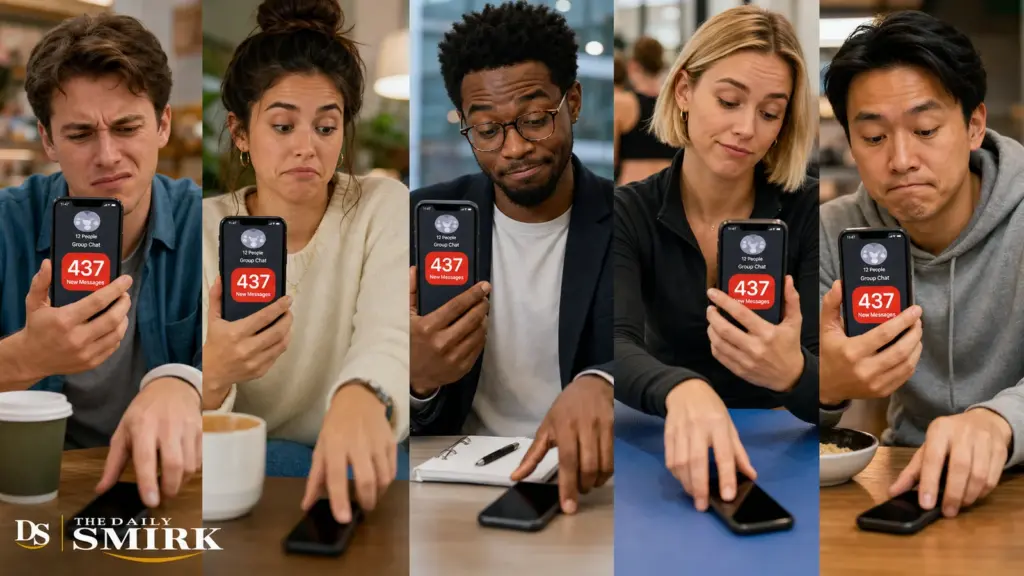
The Scene
At at 8:47 on an otherwise quiet Sunday morning, the center of attention at phones, tablets and unattended laptops across the country was a notification preview reading QUICK QUESTION FOR EVERYONE. What began as an ordinary piece of civic, family or workplace business quickly acquired the solemn rhythm of a breaking-news event. People stopped what they were doing, moved closer and began offering the kind of confident observations normally reserved for weather emergencies and parking disputes.
The episode began when millions of recipients independently saw the message, recognized the danger of engagement and chose to behave as though their devices had displayed nothing. Witnesses initially treated the development as a misunderstanding that would correct itself after a short explanation. Instead, each explanation created two additional questions and attracted another person certain that the situation could be resolved by speaking more slowly.
Read receipts accumulated beneath the message while every participant attempted to preserve plausible deniability. By then, the original purpose of the gathering had become secondary. Phones appeared. Chairs were repositioned. Somebody who had not seen the beginning started recounting it to newcomers with several details already improved.
A Practical Response Becomes a Ceremony
communications coordinator Denise Parr, the organizer who had created the original group, took control of the scene with the measured seriousness of someone who understood that any visible hesitation would become part of the story. Families placed phones face down, coworkers disabled previews and neighborhood groups moved through breakfast under a temporary pact of national nonresponse.
“It was not an emergency; I only needed a head count and perhaps two volunteers with folding tables,” communications coordinator Denise Parr said, pausing while an aide checked whether the statement created a new policy. The remark was copied into notes, repeated in the hallway and shortened almost beyond recognition before reaching social media.
The official response emphasized order, documentation and the continued availability of normal services. In practice, normal service had already been replaced by folding tables, handwritten arrows and a growing collection of people wearing temporary badges. Each new badge appeared to generate authority without reducing confusion.
The message contained no deadline, no clear request and an attachment titled FINAL_v7_USE_THIS_ONE, all recognized indicators of a conversation likely to expand. The record became so detailed that participants began disagreeing about events they had personally witnessed minutes earlier. Staff responded by numbering the disagreements and assigning them to color-coded folders.
The Other Side of the Story
Marcus Bellamy, the participant whose reply ended the silence, rejected the idea that the matter had become unnecessarily complicated. “I thought replying “following” would help people know I was following,” Marcus Bellamy said. The statement drew immediate support from several people who had not previously realized they held a position.
Supporters described the dispute as a matter of fairness, common sense and the right to expect ordinary objects or institutions to behave according to ordinary assumptions. Critics answered that common sense had already been consulted and had left without signing the attendance sheet.
The competing arguments were not entirely incompatible, but nobody wanted to be first to notice. Participants refined their positions, added examples and began referring to casual remarks as proposals. A person near the back asked whether minutes were being kept. Three people answered yes, each pointing to a different notebook.
Escalation
The silence held for three minutes and fifty-two seconds. Then Bellamy replied to all with a thumbs-up, prompting eleven question marks, six accidental stickers and a separate debate over whether the event was this Saturday or next Saturday.
The turning point arrived when the improvised solution developed procedures of its own. A line became two lines. The two lines acquired different purposes. People switched between them based on rumors from the front, only to discover they had returned to the place where they started.
By this stage, everyone agreed the situation had lasted too long, but that agreement produced no movement. Leaving would mean surrendering a place in line, a carefully developed argument or the opportunity to witness whatever happened next. New arrivals interpreted the crowd itself as proof that the matter was important.
A brief attempt to restore simplicity failed after someone requested definitions. The request was reasonable, the definitions were accurate and the resulting discussion consumed another forty minutes. Refreshments appeared without any clear sponsor, transforming the episode from an interruption into a community event.
Reaction Beyond the Room
Productivity analysts recorded a sharp decline as participants searched old messages for context and drafted responses designed to sound helpful without creating obligations.
Outside observers divided into familiar camps. One group considered the event evidence that systems had become too complicated. Another believed the problem was insufficient procedure. A third group asked for video, watched twelve seconds without context and announced a complete understanding.
Local businesses responded quickly. A nearby printer offered same-day signs. A restaurant advertised a related lunch special. One entrepreneur registered three domain names before learning the exact spelling of the central issue. None of these actions resolved anything, but they gave the afternoon a sense of economic momentum.
Experts who were contacted later agreed that the underlying issue was manageable. They disagreed on what the underlying issue was. Each recommended clearer communication, a recommendation repeated so often that it became difficult to hear clearly.
What Happens Next
As attention began to fade, staff collected temporary signs, stacked unused forms and attempted to identify which decisions had actually been made. The final list was shorter than expected but longer than anyone wanted to explain. Several participants left believing they had won; several others left believing a formal appeal had begun.
By noon, the chat had produced 214 messages and no confirmed volunteers. Parr created a second group titled ACTUAL VOLUNTEERS ONLY, restoring the nation’s silence almost immediately.
The scene returned to something resembling normal soon afterward. The chairs went back, the phones disappeared and the people who had arrived late carried the story elsewhere. By evening, the episode had already acquired a beginning that was cleaner, an ending that was sharper and a lesson broad enough for everyone to apply to somebody else.
Join the conversation
Load Facebook comments to read and reply using your Facebook account.