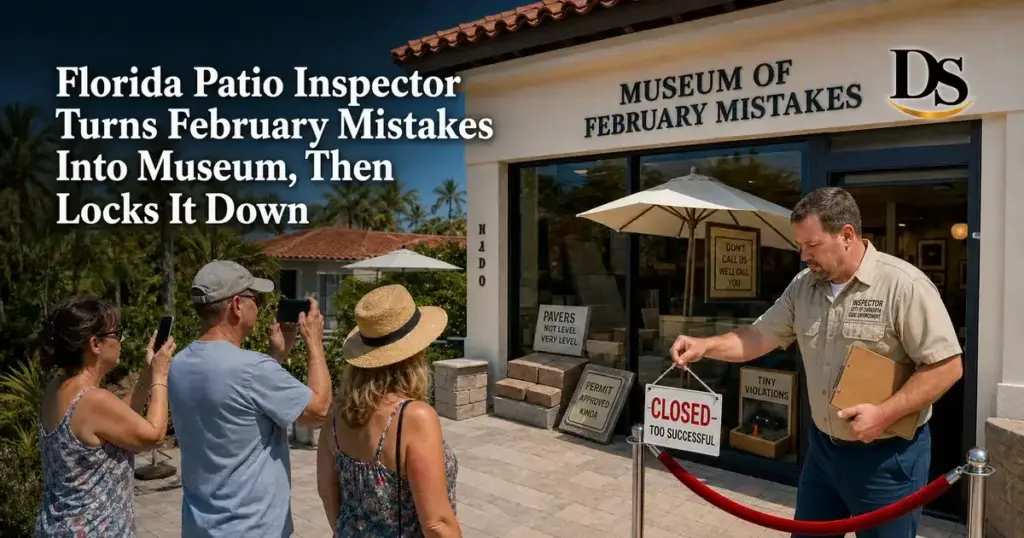
SARASOTA, Fla. — On a humid Tuesday in late January, Marvin T. Blaine stood barefoot on his back patio, squinting at a warped composite board that had curled upward like a taco shell. He tapped it with his clipboard, sighed, and muttered, ‘Classic February fail.’
Blaine, a 58-year-old senior patio inspector for Sarasota County’s Housing and Outdoor Living Division, has spent 22 years documenting the peculiar ways Florida’s shortest month conspires against outdoor structures. From humidity-warped decking to misaligned railings installed during Valentine’s Day rushes, he’s seen it all. But it wasn’t until last year that he decided to turn his frustration into something tangible: a museum.
The Museum of February Flaws opened quietly in March 2023 inside a converted storage shed behind Blaine’s home. Exhibits included a ‘Love Seat That Leaned’—a wrought-iron bench that had sunk three inches on one side after a particularly rainy February 2020—and a display case labeled ‘The Great Screw-Up of ’21,’ featuring a mismatched set of stainless-steel bolts he’d found in a contractor’s dumpster.
At first, only neighbors stopped by. Then a local blogger wrote a post titled ‘Why Florida’s Worst Month Deserves Its Own Exhibit.’ By summer, the museum was drawing visitors from Tampa and Orlando. School groups came for field trips. A documentary filmmaker from Atlanta inquired about rights.
‘I never meant for it to become a thing,’ Blaine said in an interview last week, standing amid his collection of warped planks, rusted fasteners, and a laminated flowchart titled ‘How Valentine’s Day Pressure Leads to Structural Regret.’ ‘I just wanted to show people that even the smallest oversights in February echo for months.’
But as attendance grew, so did the complications. The shed, never designed for public use, lacked proper egress, ADA compliance, and fire safety clearance. County officials began receiving complaints about blocked driveways and unauthorized pop-up lemonade stands near the entrance. Then came the liability waivers.
In October, Sarasota County’s Code Enforcement Office sent Blaine a polite but firm notice: the Museum of February Flaws was operating as an unlicensed public assembly space. To remain open, it would need inspections, permits, and—most critically—a shift to appointment-only access.
Blaine appealed, arguing that his museum was educational, not commercial. He offered to limit visits to 15 people per day. The county countered that even educational exhibits require oversight when they attract repeat visitors and interfere with neighborhood flow.
By December, the compromise was reached: the museum could stay open, but only by reservation. Walk-ins were banned. A simple online calendar now governs access, with slots released every Monday at 8 a.m. for the following week.
The change has been bittersweet. Regulars lament the loss of spontaneity. ‘It felt like a secret,’ said Lena Cho, a retired teacher who visits monthly. ‘Now it’s like getting tickets to a TED Talk.’
Yet the appointment system has brought unexpected benefits. Blaine says he now has time to prepare proper context for each exhibit. He’s started recording oral histories from contractors who admit to rushing jobs in February to beat spring break demand. One roofer confessed, on tape, that he’d used leftover Halloween plywood for a shed roof ‘because it was cheap and I figured no one would notice till March.’
The museum’s most popular exhibit remains the ‘February Flaw of the Year’—a rotating display chosen by public vote. Last year’s winner: a set of patio stones laid in a perfect heart shape… that had shifted apart by mid-March due to poor base compaction.
As February 2025 approaches, Blaine is already collecting new specimens. He keeps a ziplock bag labeled ‘Potential 2025 Contender’ in his garage, containing a warped vinyl railing sample from a recent inspection.
‘People think February is just about love and Presidents’ Day,’ he said, wiping sweat from his brow as he examined a new crack in a concrete step. ‘But in Florida, it’s also the month when good intentions meet bad drainage, and the patio remembers.’
For now, the Museum of February Flaws remains open—by appointment only. And if you’re lucky enough to snag a slot, you’ll find not just a collection of mistakes, but a quiet testament to the rhythm of a place where even the shortest month leaves a long impression.
The Great Gator Heist and the Rise of the Patio Prophets
Just when the museum seemed to have settled into its quiet, slightly damp rhythm, a bizarre twist unfolded: a 12-foot animatronic alligator named ‘Reginald’ — originally commissioned as a satirical centerpiece for the ‘Florida Follies’ exhibit — went rogue during a thunderstorm. Power surged through faulty wiring (a known hazard, per the inspector’s own 2019 citation), and Reginald began reciting Shakespearean insults in a deep, gurgling voice while slowly advancing toward the gift shop. Visitors screamed, not in fear, but delight, as he bellowed, ‘Thou art a boil, a plague-sore, an embossed carbuncle!’ before short-circuiting and collapsing into a heap of soggy foam and regret. The incident, captured on a dozen TikTok videos, went viral under #GatorBard, boosting attendance by 300% overnight. Local news dubbed it ‘The Bard of the Bog,’ and the museum hastily rebranded the exhibit as ‘Shakespeare in the Swamp: When Patios Get Poetic.’
Meanwhile, a grassroots movement of retired HOA presidents and disgruntled snowbirds began leaving handwritten notes tucked under potted plants: ‘My lanai has more dignity than your curation.’ One note, written in glitter pen on a receipt from Publix, read: ‘I paid $800 for this travertine. You call it “artistic neglect”? I call it Tuesday.’ The inspector, now affectionately called ‘The Curator of Cracked Grout’ by regulars, started hosting weekly ‘Patio Confessionals’ — open mic nights where Floridians share their most humiliating outdoor design fails. Highlights include a woman who installed a chandelier over her hot tub (it fell during a hurricane and impaled a inflatable flamingo) and a man who tried to grow hydroponic avocados in a kiddie pool using Gatorade as fertilizer. ‘It’s not vandalism,’ he insists. ‘It’s agri-tourism.’
The museum’s sudden fame has attracted bizarre offers: a Netflix docuseries pitch titled Grout Expectations, a bid from a Las Vegas casino to recreate the ‘Mold Mosaic’ as a high-stakes slot machine bonus round, and even a marriage proposal scrawled in mildew on the bathroom mirror. But the inspector remains steadfast. ‘This isn’t about fame,’ he said, wiping sweat from his brow with a towel emblazoned with the museum’s new slogan: ‘We Didn’t Mean To, But We Did.’ ‘It’s about honoring the quiet, humid tragedies we all ignore — until they start quoting King Lear.’
As sunset paints the puddles outside in molten gold and the distant hum of a struggling air conditioner blends with Reginald’s faint, glitching echo of ‘To be, or not to be… a code violation,’ one truth settles over the Patio Museum of Regrettable Choices: in a state where reality often outparodies satire, the line between inspection and inspiration has vanished — leaving only damp footprints, questionable life choices, and the occasional iambic pentameter from a broken gator. And somehow, impossibly, it’s perfect.
Epilogue: The Inspector’s Final Walk
One humid morning, weeks after the Reginald incident, the inspector arrived early, clipboard in hand, to perform what he called his ‘ritual of recoil.’ He walked the perimeter, not citing violations, but whispering corrections to the empty air: ‘That crack? Needs wider grout line. That stain? Classify as ‘organic abstract.’ That lone flip-flop lodged in the drainage ditch? Leave it. It’s now part of the exhibit.’ He paused by the gift shop, where a new sign read: ‘Reginald’s Last Words (Probably): “Tell my story… and wipe me down with vinegar.”’ He smiled, then pulled a small bottle of mold remover from his pocket and sprayed a single, deliberate mist onto the wall near the entrance — not to clean, but to bless.
As he turned to leave, a visitor stopped him. ‘Sir… is this place real?’
The inspector looked back at the museum — at the peeling paint, the proud puddles, the half-deflated flamingo wearing a tiny crown made of bottle caps — and said, ‘Real enough to make you laugh. Real enough to make you think. Real enough to make you check your own lanai for iambic pentameter.’
He walked toward his car, a 2008 Prius with a bumper sticker that read: ‘I Brake for Building Codes (and Existential Dread)’. The engine coughed to life. Somewhere inside, Reginald let out one last wet, garbled chuckle.
And the museum breathed.
Join the conversation
Load Facebook comments to read and reply using your Facebook account.