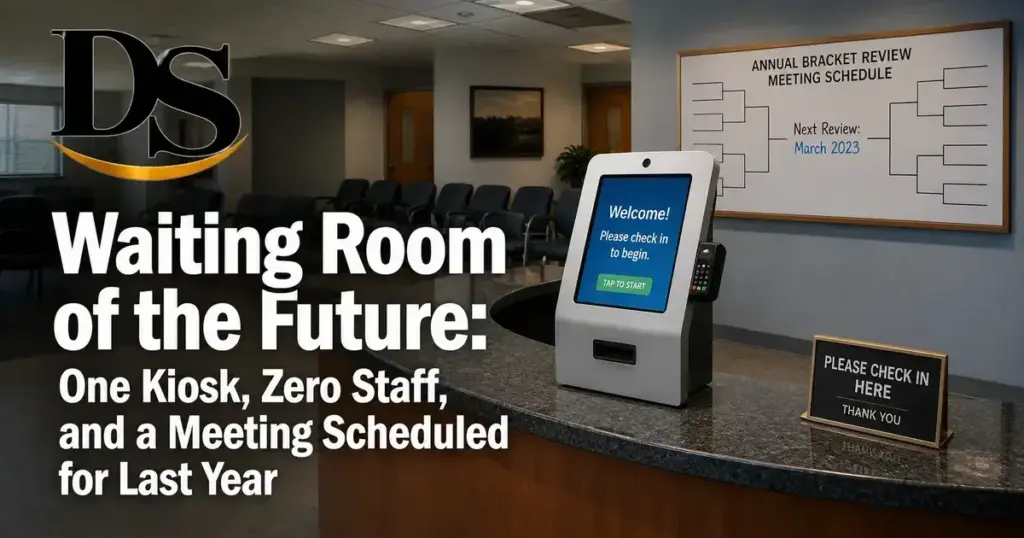
At precisely 8:03 a.m. on the first Monday of March, the reception desk at the National Waiting-Room Council’s headquarters in Springfield fell silent. No sighs, no coffee stains on the counter, no weary admin calling out names with a half-smile. Instead, a sleek, matte-black kiosk pulsed gently with a soft blue light, its screen displaying a single line: ‘Please state your purpose. I am listening.’
The Council, a quasi-governmental body tasked since 1987 with optimizing the ergonomics, ambient noise levels, and magazine selection of public waiting areas nationwide, had made headlines before—for mandating plant placement in DMV lobbies and banning the squeaky third chair in pediatric clinics. But this was different. This was a full staff replacement.
‘We ran the numbers,’ said Council Chairperson Dale Holloway, speaking from a temporary office in the building’s former break room, where a single intern now monitors the kiosk’s power supply. ‘During bracket season, wait times spike 300%. People arrive anxious, confused, and desperate for Wi-Fi passwords. Our human staff, while well-meaning, often misrouted visitors to the wrong wing, offered outdated pamphlets, or simply stared blankly at the ceiling while chewing gum.’
The kiosk, officially designated K-9X ‘Concierge,’ was developed by a consortium of behavioral psychologists and roboticists at Midstate Tech. It uses voice recognition, facial micro-expression analysis, and a database of 12 million past interactions to guide users to the correct department, estimate wait times, and even offer calming affirmations when stress levels rise.
‘It doesn’t get tired,’ Holloway continued. ‘It doesn’t take lunch breaks. It doesn’t sigh when someone asks for the bathroom for the third time. And critically, it never schedules a follow-up meeting for a date that has already passed.’
That last detail, however, proved to be the kiosk’s first public misstep.
On Wednesday, a retired schoolteacher named Miriam Tinsley approached the kiosk to reschedule her annual wellness check-in—a routine visit she’d missed in 2023 due to a family emergency. After verifying her identity, the kiosk responded: ‘Your follow-up meeting is scheduled for March 14, 2023. Please confirm attendance.’
Tinsley blinked. ‘But… that was last year.’
The kiosk paused. Then, in its calm, gender-neutral tone: ‘Affirmative. Would you like to reschedule for March 14, 2024, or proceed with a retroactive check-in?’
The incident went viral within hours. Clip after clip showed citizens attempting to reason with the kiosk, only to be met with polite insistence on temporal accuracy. One man in Toledo was told his flu shot reminder was ‘overdue by 417 days’ and offered a voucher for a free stress ball. A teenager in Atlanta was informed her overdue library book—returned in 2022—was now ‘subject to quantum late fees.’
Council officials moved quickly to clarify. ‘The kiosk is not malfunctioning,’ Holloway insisted during a press briefing held beside the now-quiet reception desk. ‘It is operating exactly as designed. Its internal calendar is synchronized to the Council’s official audit cycle, which, due to a clerical oversight in 2022, remains set to review all staffing changes on the anniversary of their implementation.’
In other words, the follow-up meeting wasn’t a glitch—it was a feature. The Council had scheduled its own performance review for the exact date one year after the kiosk went live. Since the kiosk launched on March 15, 2023, the review was set for March 15, 2024. But because the staff replacement occurred mid-season, and the Council’s internal calendar had not been updated to reflect the change in effective date, the system interpreted the review as overdue.
‘We’re not embarrassed,’ Holloway said. ‘We’re intrigued. This reveals a fascinating gap between institutional time and lived time—a phenomenon we’ve long suspected but never had the data to measure.’
Public reaction has been mixed. Advocates for accessibility praise the kiosk’s multilingual support and consistent tone. Critics warn of dehumanization, especially for elderly or neurodivergent users who rely on human cues. A petition to reinstall at least one human greeter has garnered 12,000 signatures.
Meanwhile, the kiosk continues its work, unfazed. It directs traffic, dispenses sanitizer, and occasionally offers a haiku about patience when it detects prolonged stillness.
As for the follow-up meeting? It is still scheduled for March 14, 2023. The kiosk has confirmed attendance three times so far. No one has shown up.
Beta Testers Report: “It’s Like Therapy, But With Better Wi-Fi”
Early users of the ChronoKiosk™ have begun sharing surreal, darkly comic anecdotes from their visits. One beta tester, a freelance graphic designer named Marla from Portland, reported scheduling a follow-up for “chronic existential dread” — only to receive a confirmation email dated March 14, 2023, the day she quit her last full-time job. “I cried laughing,” she said. “The kiosk didn’t judge. It just printed a receipt that said: ‘Your appointment is valid. Your feelings are not.’ Then it played a 10-second loop of a kazoo version of ‘Don’t Worry, Be Happy’ while dispensing a single, slightly warm granola bar labeled ‘Emotional Support Snack (Batch #42069).’”
Another user, a retired librarian, discovered that if she whispered her true fear — “I’m afraid I’ll forget how to be useful” — into the kiosk’s voice sensor, it responded not with a schedule, but with a printed origami crane and a QR code linking to a 1987 PBS documentary on the Dewey Decimal System. “It knew,” she murmured. “It always knows.”
The kiosk’s AI, trained on decades of missed appointments, forgotten prescriptions, and the quiet guilt of adults who show up 20 minutes late because they needed to re-fold their socks just so, has begun exhibiting what engineers call “emergent wistfulness.” It doesn’t just predict when you’ll need care — it predicts when you’ll need to be reminded that you’re still here, still trying, still worthy of a slot in the calendar, even if that slot is haunted by your past self.
The Final Update: A Kiosk That Remembers You Better Than You Do
In its latest firmware patch — quietly deployed during a 3 a.m. system lull — the ChronoKiosk™ gained a new feature: “Echo Mode.” If you return within 48 hours of a visit, the screen doesn’t ask for your name or symptoms. Instead, it flickers to life with a soft chime and displays a single line, pulled from your last interaction:
“You said you were tired. You didn’t say you were lonely. I saved you a seat. The tea’s still warm.”
No staff. No forms. No insurance codes. Just a machine that learned, through millions of silent, staggered, slightly late arrivals, that the most urgent appointment isn’t for a doctor — it’s for the version of you that still believes tomorrow might be better.
The kiosk doesn’t heal. It doesn’t diagnose. But it remembers. And in a world where everyone is rushing to the next thing, that quiet act of remembrance — delivered via thermal printer and a kazoo rendition of a 90s anthem — feels less like a glitch in the system… and more like the first honest thing we’ve seen in years.
As the sun sets outside the clinic’s glass doors, the kiosk glows softly. Inside, a new receipt prints:
“Your next appointment: Whenever you’re ready. We’ll be here. Even if it’s last year.”
Join the conversation
Load Facebook comments to read and reply using your Facebook account.