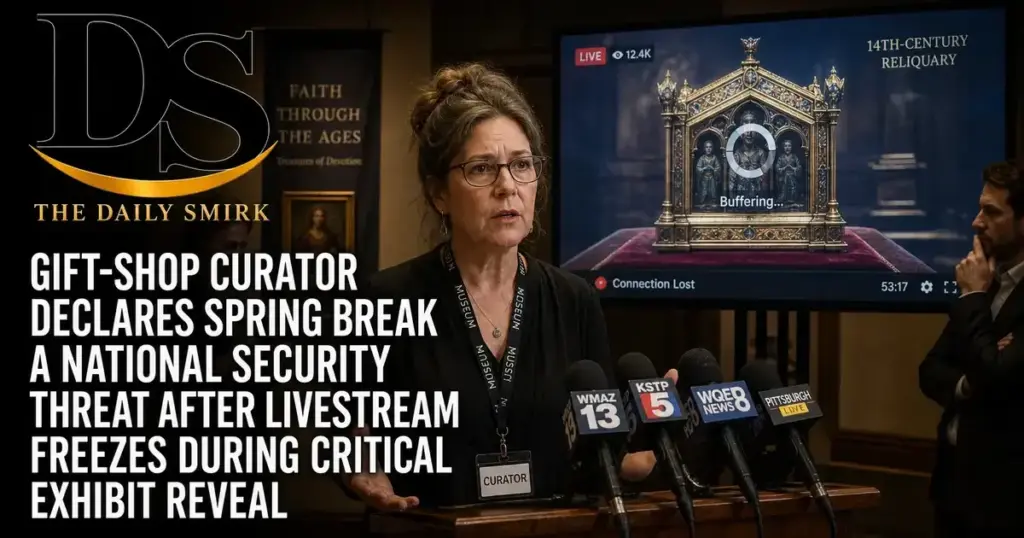
ROSEDALE — At precisely 2:17 p.m. on the first full day of spring break, the live feed from the Rosedale Museum of Antiquarian Oddities froze on a slow zoom into the gilded hinge of a reliquary said to contain the sigh of a disgruntled monk.
What followed was not a technical hiccup, but a full-blown institutional crisis — one that escalated rapidly when Marjorie P. Thistlewaite, the museum’s gift-shop curator and self-appointed guardian of visitor experience, stepped up to a podium draped in last year’s unsold tote bags and declared a state of emergency.
The Buffering That Broke the Camel’s Back
The livestream, intended to showcase the museum’s newly acquired “Whimsy & Woe” collection to remote spring breakers unable to travel due to budget airline blackouts, had been running smoothly for 11 minutes and 43 seconds. Then, as the camera drifted toward the reliquary’s intricate filigree — a detail Thistlewaite had personally insisted be highlighted in the gift-shop’s companion enamel pin line — the video stalled. The timestamp froze. The audio looped a single, strained note from the museum’s ambient soundscape: a theremin imitating a confused goose.
For 97 seconds, the nation’s remote spring breakers stared at a still image of sacred metalwork while the museum’s IT team frantically rebooted routers, checked HDMI cables, and whispered apologies to the portrait of the founder, who died in 1892 under mysterious circumstances involving a malfunctioning automat.
From Gift Shop to Crisis Command
Thistlewaite, known for her meticulous curation of novelty erasers shaped like extinct birds and her refusal to stock anything without a pun, arrived at the press conference wearing a blazer embroidered with the phrase “I Survived the Reliquary Freeze of ’24.” She carried a laminated binder titled Protocols for When the Internet Betrays Sacred Objects and opened with a statement that left reporters blinking.
“We are not merely dealing with a bandwidth issue,” she said, voice steady despite the sweat beading on her upper lip. “We are dealing with a rupture in the cultural continuum. Spring break is not a vacation. It is a ritual. And when the ritual is interrupted by a spinning wheel of death, we risk raising a generation that thinks the Middle Ages ended with a buffering icon.”
She cited declining sales of the museum’s “Monk’s Sigh” stress balls (shaped like tiny lungs) and a spike in returns of the “I �� Reliquaries” mug — allegedly due to customers feeling “emotionally unfulfilled” by the interrupted stream.
“This isn’t about entertainment,” she continued. “It’s about epistemic integrity. If we cannot guarantee uninterrupted access to the hinge’s filigree during peak leisure hours, what are we even doing here?”
Reactions Range from Sympathetic to Skeptical
Dr. Elias Vorn, the museum’s head conservator, acknowledged the technical failure but questioned the framing. “The reliquary is stable. The hinge is not going anywhere. It’s been there for 600 years. It can survive a 90-second stream interruption.” He added, off the record, that Thistlewaite had recently insisted the livestream bitrate be increased to showcase ‘the subtle tremble in the silverwork,’ a detail visible only under 8x magnification and ideal lighting conditions.
Local spring breakers were divided. Kaylen Ruiz, a sophomore from Arizona State watching on her phone between shifts at a beachfront taco stand, said, “I came for the weird history. I stayed for the drama. Now I’m invested. Did the monk sigh or didn’t he?” Meanwhile, a group of retired teachers from Minnesota, watching via projector at their community center, released a joint statement: “We lived through the dial-up era. We can handle a little buffering. But we do expect an apology email and a discount code for the postcard set.”
The museum’s PR team issued a follow-up statement acknowledging the outage, attributing it to an unexpected surge in traffic from a viral TikTok trend involving users synchronizing their spring break snacks with the theremin drone. They promised a restored stream by 5 p.m., complete with a guided narration by Thistlewaite herself, who would now wear noise-canceling headphones to avoid being startled by ambient goose sounds.
The Cultural Toll of a Frozen Frame
By mid-afternoon, the incident had spawned memes, a Change.org petition demanding “relinquary resolution rights” (misspelled and gaining 12,000 signatures), and a parody Twitter account @ReliquaryBuffer that posted only still images of medieval objects with captions like “This is where your attention span went to die.”
Thistlewaite, undeterred, used the momentum to announce a new initiative: the Spring Break Continuity Act, a proposed federal guideline requiring museums receiving public funds to maintain dual-stream redundancy, buffered content caches, and on-site humorists to distract visitors during outages.
“We must treat digital access to culture like we treat electricity or running water,” she said, adjusting her blazer. “No one would accept a hotel saying, ‘Sorry, the hot water’s out, but here’s a photo of a shower.’ So why should we accept a livestream that cuts out right when the monk’s sigh is about to be revealed?”
As the press conference concluded, the livestream flickered back to life. The camera had drifted slightly — now showing the reliquary’s base, where a tiny inscription read, in Latin: Qui timet buffers, non vivit — He who fears buffering, does not live.
Thistlewaite paused, then smiled. “Well,” she said, “perhaps we’ve all learned something today.”
Join the conversation
Load Facebook comments to read and reply using your Facebook account.